The Vocational Apprenticeship Training Model (2008) seeks to utilise behavioural learning processes built on the research foundations of BF Skinner (1958) blended with cognitive influences espoused by Gagné (1975). Mastery learning processes utilising the research of Bloom (1968) formed the basis of the initial model with further refinements to improve instructional outcomes.
Noe (2008) describes learning as a relatively permanent change in capabilities not resulting from growth processes. Furthermore, Mager weighs in with preparing learning objectives for criterion referenced instruction (1997) further supporting the value of instructional objectives as the foundation of instructional design.
The required outcome is to develop diagnostic and troubleshooting techniques in engineering apprentices to utilise diagnostic abilities in the workplace. The humanistic approach to learning is generally not undertaken at the apprenticeship level; alternately, it is usually reserved for post-trade training utilising on-the-job learning methodologies. Tovey and Lawler (2008) suggest the humanist approach is suited for highly engaged learners and generally not suited for apprentice training.
Problem based learning (PBL) supplements the cognitive learning process aiding diagnosis and trouble-shooting techniques for third and fourth year apprentices and is not utilised for first year apprentices as they hold insufficient workplace experience and workplace knowledge. As the training progresses, the behavioural approach reduces and cognitive approaches are more prevalent and utilised with greater effect. PBL is a student-centred andragogical strategy where trainees undertake a project learning the content through the facilitated experience of solving an open-ended problem.
The Vocational Apprenticeship Training Model (2008) has been revised (2016) to reflect the complex training environment undertaken in modern engineering workplaces with a distinct targeted approach to heavy duty diesel and plant mechanics. A greater emphasis has been placed on mastery learning techniques ensuring immediate performance feedback during the formative assessment stage allowing greater opportunities to achieve mastery learning during the learning intervention and relying less on the summative assessment method.
An engineering apprentice indentured to an employer in Western Australia engages in an on-the-job training contract between the apprentice, the host employer and the Department of Training and Workforce Development undertaking workplace based training for a duration of four years. As a competency based training model is utilised, the apprentice may complete their training program earlier than the listed date should they be deemed competent by both the independent assessor and employer. Regardless, a time-served model of 48 months is considered the indentured period.
Notwithstanding, should not all performance measures be met, a training extension may be granted by the Department of Training and Workforce Development after being requested by the host employer should the apprentice require further workplace skills development. The workplace training is supplemented by face-to-face learning interventions generally undertaken off-the-job at a training institute although it is considered approximately 70% of learning takes place on-the-job with the assessment phase undertaken off-the-job due to financial constraints.
As learning is now considered an active process where the brain assimilates and synthesises information, a trainee-centred approach requires small chunks of information with retention enhanced with repetition via a multi-media approach to instruction with Brylake feeling the facilitator should prioritise course material emphasis on material only of primary importance (1995).
Aligned to the Australian Qualifications Framework (2011) is the Certificate III, a qualification awarded by a Registered Training Organisation (RTO) for meeting the endorsed assessment requirements. However, when an Australian Apprenticeship is undertaken, a trade certificate is also awarded by the Department of Training and Workforce Development, a state based authority recognising the successful completion of an indentured trade incorporating on-the-job training.
In a somewhat contradictory situation, an apprentice must complete units of competency (UoC) and a volume of learning requirement based on allotted hours that align more to a diploma level qualification than a Certificate III qualification. The funded component of the qualification requires 864 hours of funded delivery to award an A class Certificate III trade qualification and is partly funded by the state government to boost workplace productivity and development although 892 hours is more common.
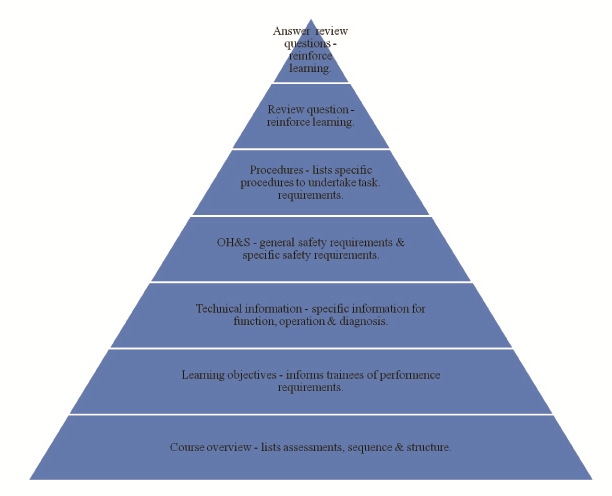
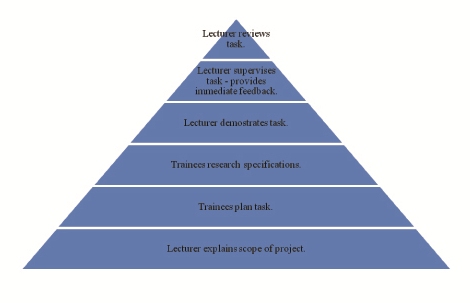
The training delivery and assessment pyramids provide a sequenced foundation building on a series of distinctive steps to achieve competence based on a bottom up approach building on the foundations of the stepped process. The training pyramids were designed to develop a base to build knowledge and skills in a sequential manner moving from the known to the unknown as skills are developed.
A training needs analysis is required to develop the learning objectives, the learning objectives provide the base foundation of the learning and assessment process. The Goldstein Systematic Training and Development model is the preferred process for customised training analysis; however, the Schiffman model (1995) is less complex for apprentice training insofar as pre-testing of trainees is not required and the needs and task assessment is two separate events.
When undertaking generic group based training, the nationally recognised and endorsed UoC provides the TNA as the industry skills councils (ISC) has developed the assessment requirements in wide consultation with industry. In such a case, undertaking a narrow TNA would defeat the advantages of undertaking industry wide consultation; in such a case, learning objectives are developed from the UoC utilising the elements, performance criteria, required skills and required knowledge.
The analysis process undertaken for contextualised training requires a set of seven distinctive steps following the Rothwell and Benkowski model (2002); these are:
- Performance analysis.
- Learner analysis.
- Work setting analysis.
- Instructional setting analysis.
- Job analysis.
- Task analysis.
- Training needs analysis.
The instructional design process seeks to:
- Identify the performance problem.
- Determine the learner characteristics and preferred learning styles.
- Provide a task analysis.
- Formalise instructional objectives.
- Design the content and sequence.
- Implement instructional strategies.
- Evaluate the instruments.
The training needs analysis aids the identification and development of clear and precise learning outcomes that are linked to measurable performance outcomes with a transfer of learning that is monitored and evaluated. Wohlers (1995) believes individualised instruction techniques require objectives clearly stated in terms of performance. The workbook (and accompanying electronic presentations) utilises programmed learning techniques built on the foundations of BF Skinner (1958) listing the assessments, sequence and structure targeting adult learning principles of andragogy as identified by Knowles (1980).
Preferred learning styles in the model are addressed utilising the Felder-Silvermann model (1987) with five preferred learning style groups and two sub-groups embedded within each of the five groups. Cole (2006) identifies the availability of numerous learning models, Kolb\’s learning styles support reflective observation, abstract conceptualisation, active experimentation and concrete experience. Buckley and Caple (2004) suggest the Honey and Mumford experience model where learning through experimental learning as a transformational experience.
The workbook design process, as illustrated in the appendix utilises a linear process to:
- Determine learning objectives.
- Sequentially link the content to the learning objectives.
- The summary linked sequentially to learning objectives/content to aid.
- Review questions are linked to learning objectives to measure retention.
The learning objectives inform the learner of performance requirements, as the vocational education and training (VET) sector is build on assessment, the performance requirements builds the foundations of the cognitive function of learning. Selecting the training methodology for the delivery requires careful selection where blended learning strategies are preferred to address learning styles utilising formal and informal methods (Rowen, 2007). Armstrong (2009) supports blended learning methodologies for improved outcomes for trainees, this supports learning styles theory.
The learning outcomes are a three-part statement precisely specifying:
- Performance.
- Standard.
- Conditions.
The learning outcome statement lists:
- What a learner is expected to be able to do as a result of the learning experience (performance).
- The level of performance in terms of time, accuracy and completeness of the tasks involved (standard).
- The facilities and constraints under which the assessments are to be conducted (conditions).
The learning outcomes are statements that precisely specify to the trainee the measurable outcome that must be achieved by the end of the training session. The learning objective must be a verb precisely stating in observable and measurable terms the learning or performance outcome.
A trainee should know before training commences four important issues, these are:
- What required knowledge is the trainee required to have to perform the task.
- What the trainee is expected to do to perform the task.
- Under what conditions is the trainee required to perform this task.
- What standard is the trainee required to perform the task.
The practical assessments are linked to the learning objectives; the practical assessments must be original equipment manufacturer inspection, testing, adjusting, repair, overhaul and reporting procedures. The practical assessments must be actual workplace tasks that are undertaken by qualified and competent staff in the workplace. Practical assessments gather direct evidence allowing the assessor to base a judgement of competence
The required knowledge assessments are linked to the practical assessments and must follow the guidelines of:
- Name the components.
- State the operation.
- Reading specifications/reading drawings/writing reports.
- Embedding occupational health and safety (OH&S) processes.
- Diagnosis.
Gagné’s Nine Events of Instruction is a model well suited to the mechanical trades training apprentice, insofar as adult instructional systems were initially designed during World War II during periods of skills shortages to efficiently undertake effective training. Gagné’s instructional model is enhanced when presenting the stimulus to the learner utilising the Felder-Silverman learning styles model as a complimentary tool enhancing training delivery. Utilising Gagné ‘s conditions of learning (2005), the emphasis on creating learning interventions for effective instruction revolve around creating a inclusive learning environment.
Gagné’s Nine Events of Instruction (1992):
- Gain attention.
- Inform learners of the objectives.
- Build on prior knowledge.
- Present the stimulus.
- Provide guidance.
- Elicit performance.
- Provide feedback.
- Assess performance.
- Enhance retention and transfer.
The instructional design model used to design the learning programs includes a workbook for verbal learners; the graphics in the workbooks cater for the visual learners with the aid of PowerPoint presentations and the lecturer reinforcing the content for sensing learners. Intuitive learners prefer the diagnostic guides and projects while the group based practical projects assist active learners prefer to work in team, reflective learners tend to work more efficiently alone.
The learning objectives and summary sections assist the global learners while the content is presented in small sections and a sequential manner for sequential learners. Information is then presented from general to the specific catering for deductive learners while inductive learners prefer the practical projects. Audio, visual and kinaesthetic learners develop the knowledge and skills through the workbook, face-to-face presentations and practical projects that are linked to their actual working environments.
Furthermore, programs where no workbook exists where learners are required to take notes receives an inordinate volume of complaints. It may be argued that learners have grown used to student workbooks; however, this tends to provide anecdotal evidence supporting programs utilising adult learning principles supplemented with targeted support materials.
The technical aspects of training are introduced during the third phase of delivery; the course overview is a one off event at the beginning of the course. Should a course be conducted over a number of days, there is no need to revisit the overview. The learning objectives should be broken down into smaller segments using chunking to break the content into sub-tasks. Miller (1956) advocates the use of chunking to improve the overall retention of information; the presentation of information in small chunks allows learning objectives, a description and a graphic, drawing, specifications or a table.
Occupational health and safety procedures are introduced within the content of each task, this is to embed OH&S within each task to prevent a general apathy to OH&S issues forming. As such, it is encouraged embed OH&S requirements into each task instead of attempting to undertake a general procedure.
The task procedures for practical projects and assessments are discussed in the training room before undertaking simulated workshop training, it is encouraged for instructors to take trainees into the workshop environment to undertake explanations on actual working components and machines.
The review questions linked to the learning objectives are answered by the instructor and may be completed before or after workshop practice to reinforce learning. It is encouraged that the review questions are answered after the trainee has been given the opportunity to practice on the component or machine allowing the trainee to physically engage in learning activities. Reinforcement theory is encouraged during the feedback stage as the workshop practice is being undertaken to provide high quality and instantaneous feedback.
The practical project learning pyramid begins with the lecturer explaining the scope of the project, the trainees then plan the task utilising employability skills embedded into the project. The trainees research manufacturer specifications, charts, schematics, diagnostic guides, tables, manuals and/or computer programs to undertake the project. This includes all OH&S requirements including a Take 5, JSA or a specific company or site requirement.
The lecturer demonstrates the task using manufacturer procedures, special service tools and techniques. The trainees then undertake the task under the supervision of the lecturer providing immediate and concise feedback on performance. The training manual, Assist in the provision of on the job training (2008) listed the training process of tell, show, do as an instructional event. Amendments to the original process saw review added to the instructional sequence to embed learning through immediate reinforcement.
The EVOK method relies on four steps for describing a task to be carried out, the method is:
E Explain the task.
V Value – give the task a value relevant to workplace performance.
O Objective – state the objective.
K Key points.
- Explain – the task so that the trainee is in no doubt what they are required to do.
- Value – adult learners need to know why they are performing a task, explain how it fits into the context of the whole job and why they need to know this.
- Objective – state the objective in a single sentence.
- Key points – break the task down into sub-tasks linking the sub-tasks together beginning at the most simple and moving to the most complex.
Key points are anything in the sub-task that might:
- Affect the safety of the task.
- Affect quality of the output or process.
- Cause injury or damage.
- Make the task easier to perform.
- Provide special information.
The updated instructional sequence has been updated to:
- Tell.
- Show.
- Do.
- Review.
Tell – explain to the trainee the task they are expected to perform, the conditions under which they have to perform the task and the standard of performance expected using the EVOK method.
Show – demonstrate the task to the trainee using a logical sequence, outlining the steps as you go showing the key points and using the training plan using correct methods and tools.
Do – Allow the trainee to practise the skills they has been demonstrated by the instructor. The personal feedback is offered to each individual and team undertaking workshop practice.
Review – providing the trainee with feedback during and after the training session is an important method of reinforcement theory.
Providing the trainee with immediate feedback whilst undertaking the task is a paramount aspect of an effective feedback strategy. Following up with further feedback at the completion of the training session is an important aspect of reinforcement theory.
The PISOV method is used to reinforce the EVOK method to summarise the session:
P Positive reinforcement – state what went right during the session.
I Identify – identify problems encountered during the session.
S Solve – solve the problems identified during the session
O Objective – restate the objective.
V Value – give the task a value relevant to workplace performance.
After completing a training session it is important to reflect on the effectiveness of the session or program. Training is generally aimed at achieving results, so how do you know the training was relevant, effective and targeted at meeting the trainee’s needs? Competence is assessed when the trainee is able to perform the task to an element level including all performance criteria including all required knowledge and skills with employability skills embedded into the task, these are:
- Task skills – the ability to perform individual tasks.
- Task management skills – the ability to manage a number of different tasks within a job.
- Contingency management – the ability to respond to irregularities and breakdown in a routine.
- Role environment – the ability to deal with the responsibilities and expectations of the working environment and to be able to work with other people.
Ask the following questions:
- What was the purpose of the training?
- Did the session meet the performance requirements?
- Was there a transfer of knowledge, skills or attitude?
- Could the trainee perform the task in a different environment?
Training evaluation must focus on:
- Training delivery methods.
- Training content.
- Training environment.
- Transference of knowledge, skill and attitudes.
- Key performance indicators.
The definition of quality is based on the customer‘s perceptions of the product/service design and how well the design matches the original specifications with the ability of a product/service to satisfy the implied needs and is achieved by conforming to established requirements within the organisation (Apply quality procedures, 2007).
References
Australian Qualifications Quality Council. (2011). Australian Qualifications Framework – first edition. Department of Education, Employment and Workplace Relations.
Armstrong, M. (2009). Armstrong’s Handbook of Human Resource Management Practice – 11th edition. Kogan Page, 120 Pentonville Road, London N1 9JN, UK.
Buckley, R., Caple, J. (2004). The Theory & Practice of Training – 5th edition. Kogan Page, 120 Pentonville Road, London N1 9JN, UK.
Cole, K. (2006). Management: Theory and Practice – 3rd edition. Pearson Education Australia, Unit 4, Level 2, 14 Aquatic Drive, Frenchs Forest, NSW, 2086.
Felder, R. (2010). Are Learning Styles Valid? North Carolina State University.
Gagné, R., Briggs, L. Wager, W. (1992). Principles of Instructional Design – fourth edition. Fort Worth, TX: Harcourt Brace Jovanovich College Publishers.
Gagné, R., Wagner, W., Golas, K., Keller. (2005). Principles of Instructional Design – fifth edition. Wadsworth, Cengage Learning, 10 Davis Drive, Belmont, CA, 94002-3098.
Knowles, M. (1980). The Modern Practice of Adult Education: From pedagogy to andragogy. Cambridge: The adult education company. 888 Seventh Avenue, New York, 10106.
Lockee, B., Moore, D., Burton, J. (2004). Foundations of Programmed Instruction. Charter 20, Handbook of Research on Educational Communications and Technology, pp.545-569.
Mager, (1997). Preparing Instructional Objectives: A critical tool in the development of effective performance – 3rd edition. The Center for Effective Performance, Atlanta, Georgia.
Miller, G. (1956). The Magical Number Seven, Plus or Minus Two: Some limits on our capacity for processing information. Psychological Review, 63 (0) pp. 81-97.
Noe, R. (2008). Employee Training & Development – fourth edition. McGraw-Hill Companies Inc, 1221 Avenue of the Americas, New York, NY 10020.
OHalloran, J. (2007). Apply Quality Procedures. Swan TAFE, Burslem Drive, Thornlie.
OHalloran, J. (2008). Assist in the provision of on the job training. Swan TAFE, Burslem Drive, Thornlie.
PADI International. (1995). The Best of the Undersea Journal. Santa Ana, CA, 92799-5011
Rothwell, W., Benkowski, J. (2002). Building Effective Technical Training: How to develop hard skills within organizations. Jossey-Bass Pfeiffer, a Wiley Company, 989 Market Street, San Francisco, CA, 94103-1741.
Rowen, R. (2007). Workplace Learning: Principles and Practice. Krieger Publishing Company, Malabar, Florida.
Tovey, M., Lawler, D. (2008). Training in Australia – 3rd edition. Pearson Education Australia, Unit 4, Level 2, 14 Aquatic Drive, Frenchs Forest, NSW, 2086.
Appendix:
Workbook Learning Pyramid
Practical Project Learning Pyramid












 Observations in an undemocratic world