The threat posed by ISIL to all countries

It is being debated by some members of the community that ISIL does not constitute a threat to the citizens of Australia, that we should just let them go at it in their part of the world while keeping quiet and they will leave us alone. This line of thinking is naïve at best and dangerous at worst. ASIO has reported they have lost track of about 60 odd people travelling to the conflict areas, they are suspected of training and fighting with the ISIL forces, they will at some stage return to the shores of Australia if not killed in action. They are now unsure exactly who they are and where they have been.

Just recently, two police officers were stabbed by a person of interest in Melbourne as he voluntarily came into a police station for questioning, he had already had his passport cancelled. Whilst shot and killed by the officers, he had lunged at the officers wounding both, he had in his possession a longer knife, one presumes for decapitating the slain officers and an ISIL flag folded up in his pocket. It is believed he was to upload the pictures of the decapitated officers to social media draped in the ISIL flag.

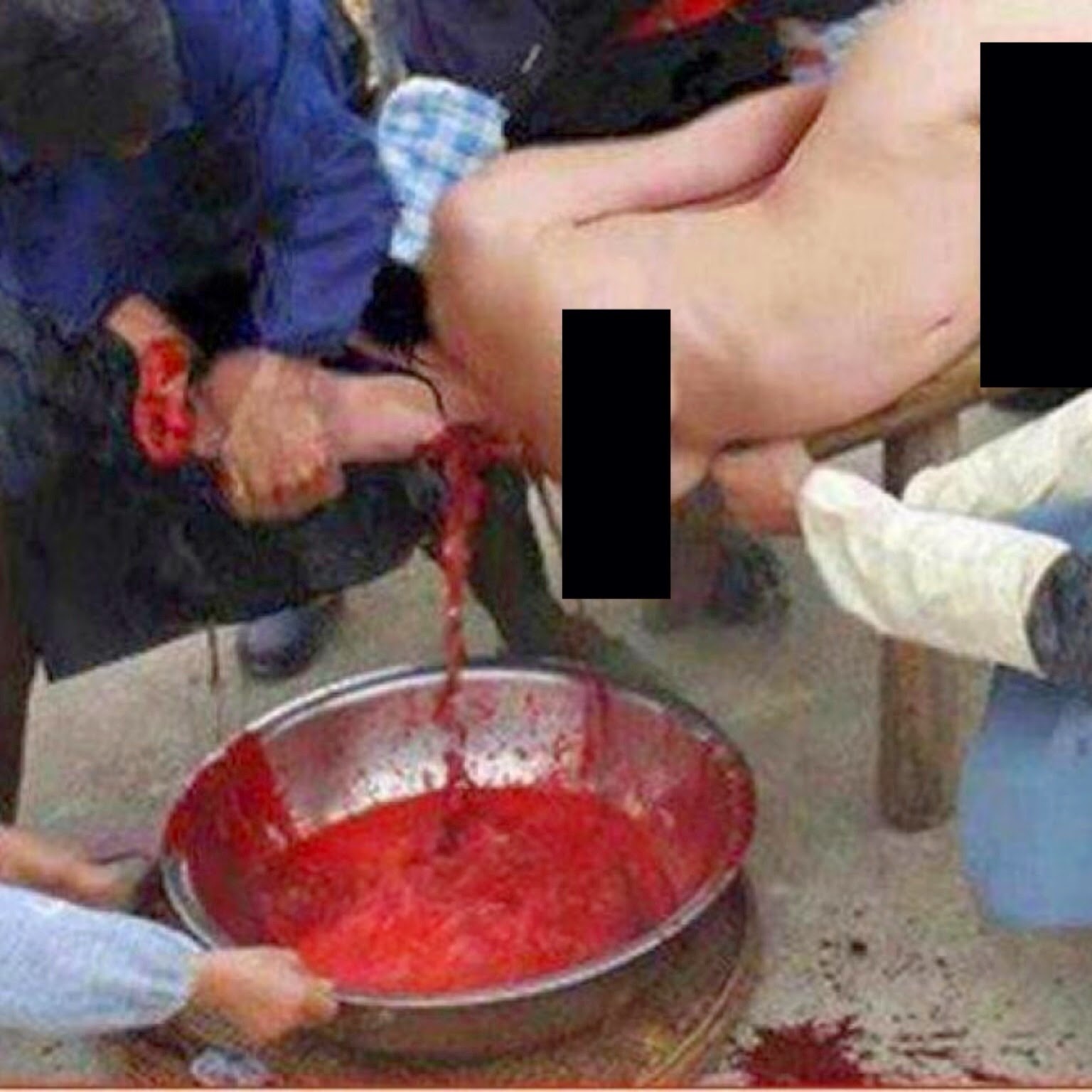
The graphics posted on this page are very confronting, I make no apologies for this as these images are freely found on the internet under a basic Google isis search. For a bunch of people seeking to take the world back to the dark ages, they are amazingly proficient in the use of social media. Beheading and crucifixions are taking place in public places to encourage public viewing and one supposes to take photographs and video to upload.

ISIL are using such images as a measure to subdue people through fear, being shot is immediate while beheading is a slow excruciating death.
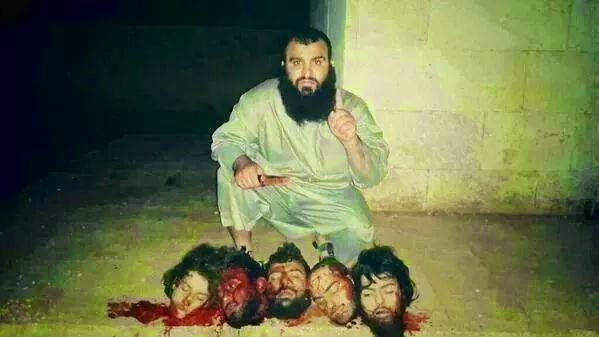
The image of the James Foley beheading has been confirmed as correct, a number of other images are yet to be confirmed but are still being reported whilst a large number have the ISIL flag in the background to confirm the identity of the group. An image of a beheaded girl in a blue dress has been circulating for a number of years and is thought to be taken in Syria and committed by the Assad regime. It is though this is done to encourage western governments, chiefly being the United States to intervene in the conflict.
Do we have the wrong priorities when selecting heroes?

I was sitting on my lounge chair on Saturday watching the highly disappointing AFL grand final capitulation and the post-game medal presentation. The young boy who handed Hawthorn Luke Hodge his premiership medal told him “you are my hero” and it got me wondering, do we have the wrong priorities when selecting heroes?

Having never met the guy, I have no doubt Luke Hodge is a good guy, we all know he is a splendid captain and exceptional footballer. However, he is a footballer first and foremost; he is not a scientist, a doctor, engineer or lawyer. These are the people making a difference in society, not sportspeople, they are lightweight entertainers.

He is not quietly researching bio-medical solutions, tackling the big issues of eradicating the world of preventable diseases, a civil rights activist or fighting poverty. Yes, I understand the club requires players to perform community service as part of their contracts, this is a positive outcome for the community in some respects.

There are a worthy number of worthy unheralded heroes in the professions such as science, engineering and medicine to name just a few. I only hope we change our priorities as a society placing less emphasis on the achievements of sportspeople and more on the achievements on our unsung heroes. Sports is escapism, this is just entertainment, it is not art, it is training and application of skills admittedly to a high level.

What happened to Netscape?

Netscape was an early innovator in the fledgling internet technology industry. Before the internet boomed and became a part of everyday life, Netscape was the first mover as an embryonic search engine providing technological services for content providers to customise web content. Now, with so much user generated content on the web, it is almost incredulous to fathom that in the early 90s, business enterprises existed purely to generate web content.

The Netscape web browser, the then dominant browser in terms of market share, lost the majority of that share to Microsoft’s Internet Explorer during what was belatedly described as the first of a number of browser wars. Following immense competitive pressures, consumer usage of Netscape fell from over 90% market share in the mid 1990s to less than 1% by the mid 2000s. A number of strategic decisions led to Netscape’s rapid demise including the charging of consumers a monthly fee to use the browser.

The decision by Microsoft to load Internet Explorer for free on all new Windows powered computers pretty much rendered Netscape’s business plan obsolete. Interestingly, American and European authorities launched anti-trust action against Microsoft following massive anti-competitive competitive breaches.

The action undertaken by both American and European authorities against Microsoft saw regulatory authorities winning large settlements forcing Microsoft to reveal source codes or face further fines. The damage however had already been done to Netscape, it was a case of too little, much too late.

Netscape, credited with developing the Secure Sockets Layer (SSL) protocol securing online communication with SSL technology is still widely used to secure internet communications. JavaScript, the highly successful client-side scripting of web pages, another Netscape innovation, is still the most widely adopted programming language.

Netscape was a publicly traded company on the NASDAQ exchange; floated in 1995, the stock was publically traded an until 1999 when it was acquired by America Online (AOL) in a pooling-of-interests transaction. The deal, ultimately worth $10 billion USD involved complex cash and script transactions ensuring Netscape technology was utilised by a dominant internet business.

Shortly before the AOL acquisition, Netscape released the source code for the browser creating the foundations of the Firefox browser with the Mozilla Corporation coordinating future future development of the browser. Mozilla fully rewrote the entire source code with all future Netscape releases based on the rewritten code, the protocols now power the successful free-to-download Firefox browser.

One could argue that while the Netscape browser is now an almost forgotten relic of internet history, a number of innovations outlived the initial product forming the basis of contemporary online software. The product life cycle of the information age is relatively short, the initial challenge was how to not only develop the technical aspects of the business but how to develop a sustainable business plan generating revenues to finance the research and development providing a return on investment. Out of the ashes of Netscape rose Firefox, technically the best of the current browsers with the strongest technical protocols.

Greyhound gift fee ripoff

Greyhound is an excellent business, yet why do they have to rip off clients with an $18 gift fee? I am now a fan of Greyhound after catching numerous buses across America, unfortunately I only had four weeks, there was so much more I wanted to see.

It is amazing though, to book a ticket for another person will leave you with an $18 gift fee. I learned of this after not unchecking a box. I have to ask, under what circumstances would a gift fee be warranted? This fee discourages customers from patronising your business instead channeling potential customers to rival bus companies such as Megabus, trains such as Amtrack or even airline travel in certain circumstances.

I made a mistake booking a ticket online, I was overcharged so when I brought my concerns to Greyhound staff on the day of my departure, they obligingly organised a cash refund on-the-spot. I must say, this immediately endured me to Greyhound, my normal experience is a fight to the death for a refund. But why charge such a fee in the first place when you risk driving customers away for very little benefit?

The Topography of Terror

The lessons of history must be highlighted so as to not be repeated, this is an excellent display to remind us of a period of time when the world sunk to the depths of depravity. We have learned from textbooks and video the reach of the Nazi party, their organisation and objectives.


Really, as a world community, we haven’t learnt that much, the current regimes are just far less organised. This is why we need to analyse and review, this is where we learn from history, this is an outstanding museum that educates us on the horrors of evil regimes. 

The topography of terror in Berlin is the former Gestapo and SS headquarters, this was demolished after the war and used as a dumping ground for the reconstruction and later a car park. Naturally, it is painful as a nation to keep returning to a period of history that most would much rather forget. However, the Gestapo and the SS were mandated with subduing the population and the museum provides some interesting insights into the period.

2014 South Fremantle district grand final

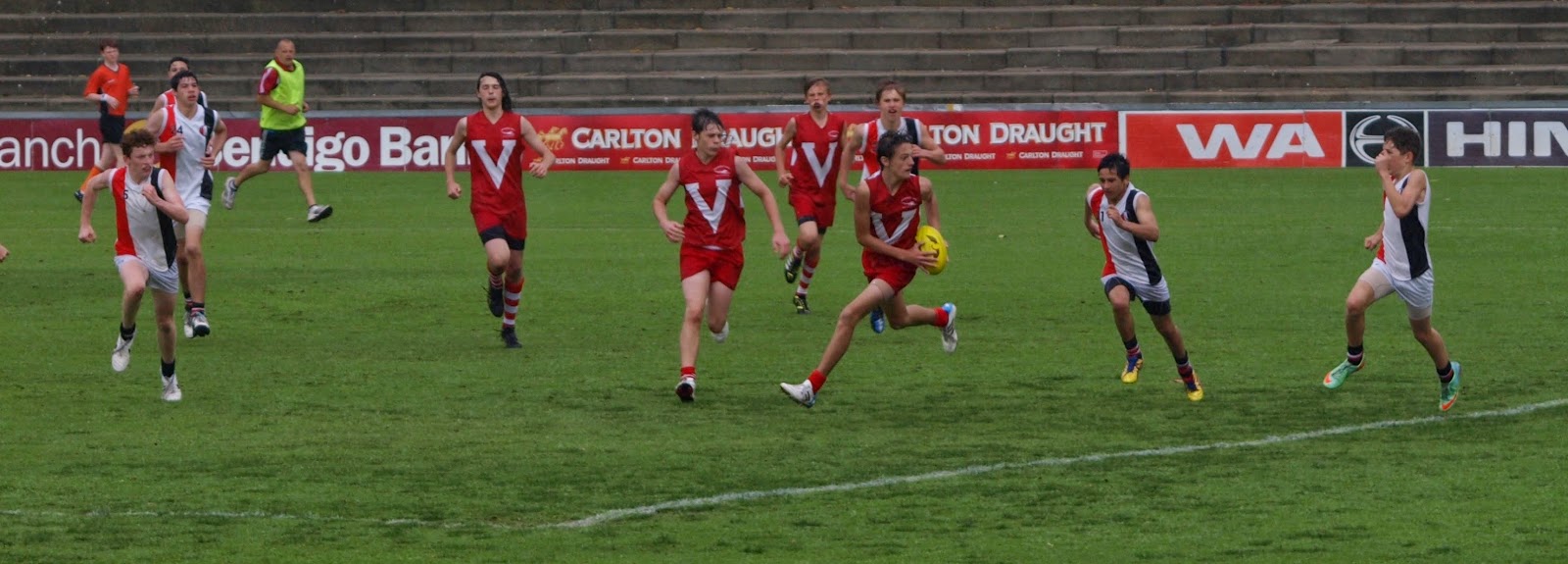
I was lucky to attend the Australian Rules Football junior Grand Final fought between South Coogee, regarded as overwhelming favourites and Jandakot Jets on Sunday the 21st of September 2014 at Fremantle Oval. This is the home ground of the Fremantle Football Club, better known as the Dockers, a leading AFL professional football team.

My nephew, Samuel De Jesus was deemed fit and selected to play despite only just recovering from a severe bout of the flu. He was able to train during the week ending up winning plenty of contested ball throughout the game.

The South Coogee Football Club, undefeated throughout the season was pitted against the fast running Jandakot Jets who have shown to be very competitive and capable. During the finals series, Jandakot proved to be more than capable of causing a major upset to the red hot favourites.

Fighting to the end and never giving up, the Jandakot Jets made the most of their limited scoring opportunities kicking 4.0 (24) with South Coogee booting 9.9 (63) to remain undefeated during the 2014 season to become 2014 premiers.

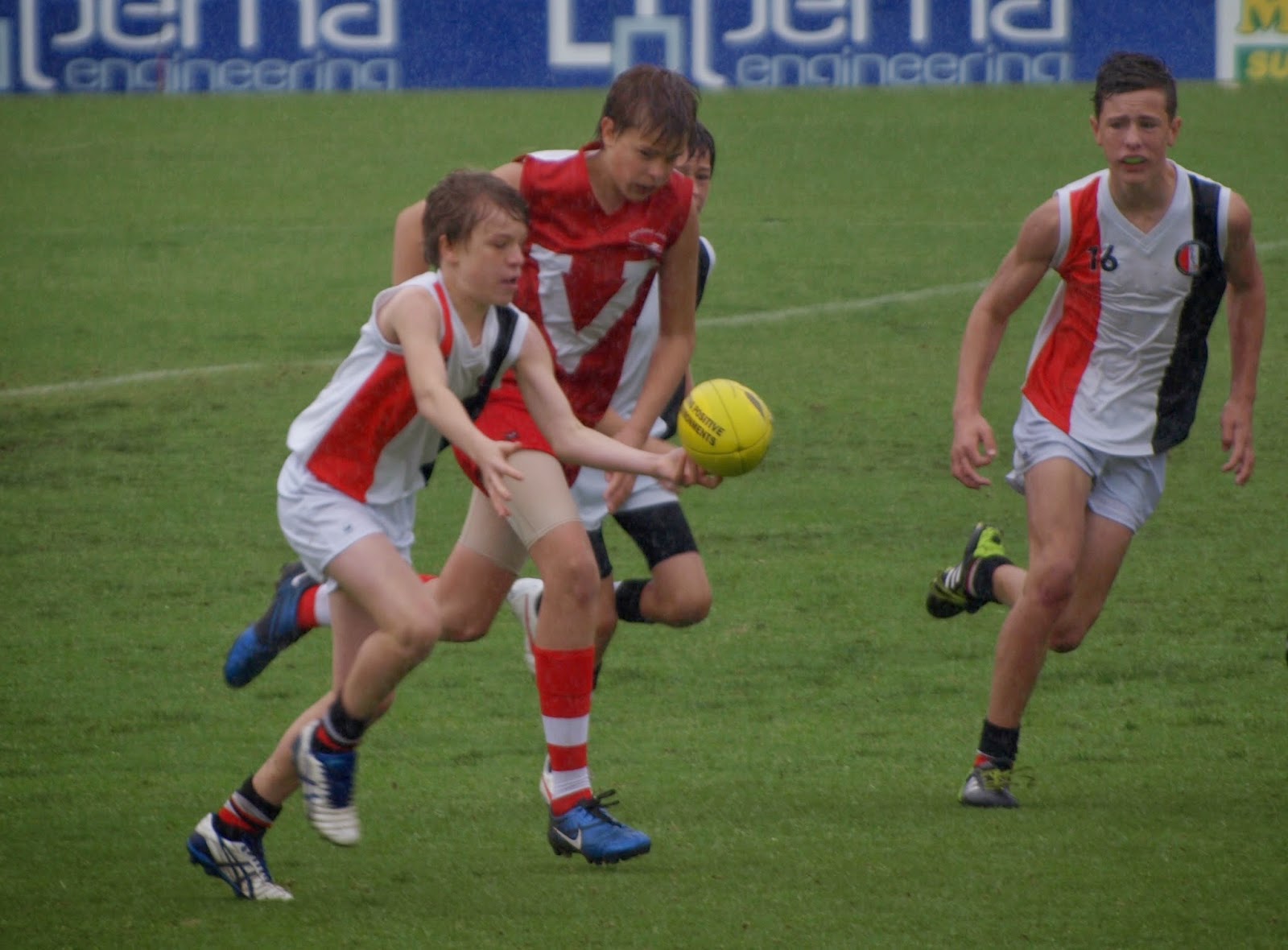
The conditions were wet and slippery, the rains started just before bounce down with the showers increasing as the game progressed. The day before, a record September day of sunshine saw the mercury hit 36 degrees Celsius, Sunday was a whole different issue.

Marking the ball was extremely difficult under such adverse conditions, moving the ball forward from every contest was slow with no team breaking the game open.

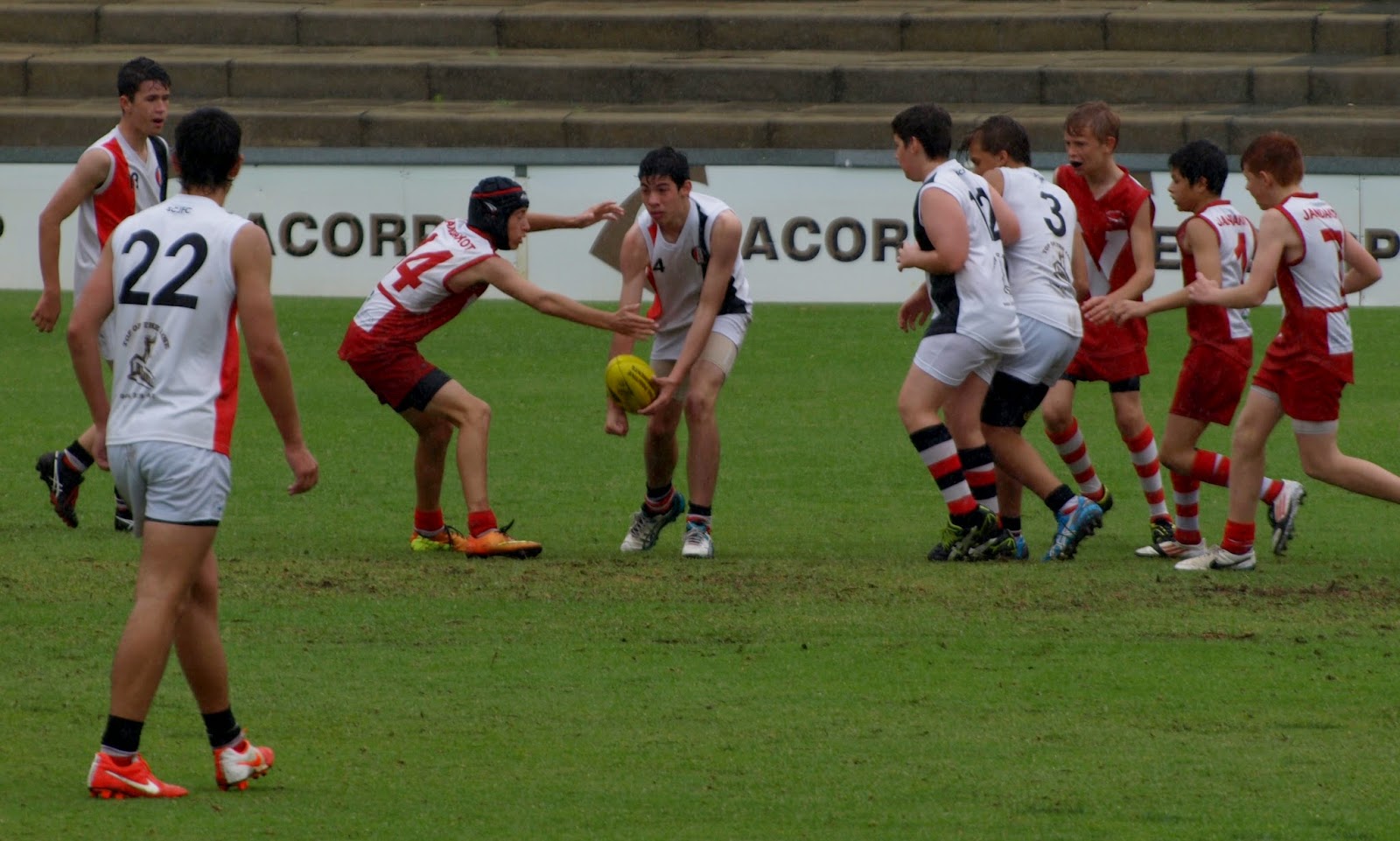
Plenty of packs developed around the ball, there was plenty of stoppages with the umpires calling play-on at every opportunity. When kicking out from goal, the old style huddle saw players breaking into space with set plays.

The handball was the key to success under such trying conditions, moving the ball out of congestion and into clear space paid dividends. Fast ball movement, run and carry and kicking long didn’t work, the team that quickly adapted to the conditions was the team that was going to dominate.


The game was broken open in the final term, Jandakot was still in with a big chance halfway through the quarter with South Coogee belting through a host of unanswered goals to finally shatter the aspirations of the Jandakot players.

Snapchat – defying financial gravity

Evan Speigel, a product design major and Reggie Brown were both Stanford University students when they developed an application for a product development unit they were studying.

According to the Shapchat blog, Bobby Murphy who was studying mathematical and computational science at Stanford was brought in to write the source code for the application. Their first project, Future Freshman failed to gain traction; however, they found they worked well together. The next project presented to the class, the mobile app that shares photographs then disappears in a matter of seconds received a less than positive response from class members.

They felt not only would people not use the app, the only ones that do would use it for sexting; as it happens, it is pretty close to the mark. A concern is the major user demographic is below the age of 16; Snapchat Inc does not condone the use of the app for pornographic use. Speigel stated in the company blog that stories of job hunters undertaking emergency de-tagging of Facebook photographs before job interviews provided the inspiration for the development along with editing blemishes out of photographs to be uploaded to the internet.

Instead of photoshopping photographs on a personal computer, photographs taken with smartphones can be immediately edited and uploaded on Android and iOS devices. I love studying entrepreneurial ventures knowing full well that I will not be investing my own funds in such a start-up after losing plenty of money in my own eCommerce start-up. It is of some concern that Snapchat Inc does not have a revenue stream, yet funding of $13.5 million from Benchmark Capital was confirmed in February 2013 valuing the company at $60 to $70 million.

Facebook Inc then made an offer of $3 billion that was rejected by Speigel with Google Inc making an offer of $4 billion to acquire the business, a further $50 million was required in venture capital, one supposes to keep the business solvent. In a move resembling the Facebook fallout; co-founder Reggie Brown, sidelined from company ownership over a yet undisclosed dispute filed a lawsuit for loss of earning potential.

Further significant issues include photographs don’t actually disappear and can be saved and/or retrieved, the collection of personal data and then the security of the data collected. I don’t use the app, I am however at a loss to how a business requiring significant venture capital with no revenue firstly receives acquisition offers of up to $4 billion and secondly has the audacity to decline acquisition offers by the leading tech companies in the sector.

Is Dale Steyn a sook?

The recent media speculation surrounding the Michael Clark sledge to South African paceman Dale Steyn is not abating. We all know Steyn loves to sledge batsmen; he himself is a world class sledger initiating numerous exchanges. Does that mean he, as a tail-end batsman, he is exempt from sledging? He feels that particular sledge was very personal and Clarke should apologise; video evidence may suggest that Clarke has already done so.

Recent ball tampering fines by South African bowlers Vernon Philander and Faf du Plessis in the past 12 months have tarnished the South African cricketing reputation to such an extent that the South African ethics committee publicly stated that “they are deeply concerned at the practice feeling that such behaviour cannot be tolerated from the national team.”

Many media commentators are asking, what exactly did Michael Clarke say to Dale Steyn? Why did he take the comment so personally? Why has he taken to the media to vent his anger? Maybe, just maybe Clarke questioned why Steyn is able to gain early reverse swing in non-conducive conditions while other bowlers are unable to do so?

Brent Harvey needs to take a hard look at himself

The precedent was set earlier in the season, if Brent Harvey initiates a bump on Joel Selwood off-the-ball making head high contact and cutting him above the eye – he will be missing game time during the finals. Selwood was running with with his defender behind him, he was watching the play and didn’t even see Harvey coming – that’s not courageous. Selwood required stitches to keep playing then needed more stitches after the game to seal the wound correctly. Harvey is just a thug, there is not much defence here, it is pretty simple really. 


You make head high contact, you are suspended – it is that easy. Harvey has to show self-discipline, something he has consistently failed to do. This is Harvey’s first week back after a three week suspension – too bad. North Melbourne are trying to argue insufficient force – the blood running down Selwood’s face would indicate otherwise. Brent Harvey, the nasty little squealer should man up, he initiated contact when the player was not looking, he split Joel Selwood’s eye and then screams when he is suspended for a preliminary final – it wasn’t an accident.  

Hamlin Bay 2010 Cabernet Sauvignon

Opening a 2010 bottle of Hamlin Bay Cabernet Sauvignon with my father to watch the 2nd semi final between North Melbourne and Geelong on Friday night was an interesting affair. After being introduced to Hamlin Bay through a wine club a number of years back, I always seek out a bottle whenever I am in a bottle shop.

You have to look hard at the smaller bottle shops, the large chains tend to only carry certain lines of high producing vineyards, this smaller boutique winery struggles to supply the chains with volumes. What the do serve up though is high quality at small volumes. Looking at the tasting notes; the 2010 was described as having aromas of red fruits and cassis dusted with chocolate and cocoa on a savoury background. That got me thinking, I have no idea what cassis flavours are so a quick google search of cassis first landed me on webpage describing a commune east of Marseille in the Provence-Alpes-Côte d’Azur region of southern France near Bouches-du-Rhône.

After redefining my search to cassis flavours; I then learned this refers to an intense blackcurrant flavour, this I actually determined for myself. I was then intent on identifying the cocoa and chocolate overtones, they were there, although not big and bold, there was hints of chocolate flavours. The tasting notes also described the wine as having a deliberately moderate pallet, a refined line of flavour, resting on a fine grainy tannin backbone. I thought the tannins were fine, this cab sav was full bodied whilst remaining subdued and stylish. This wine has a fairly good pedigree with 14 months in French oak, 25% was new oak with the remained second hand. I like this winery, I love drinking what they produce.