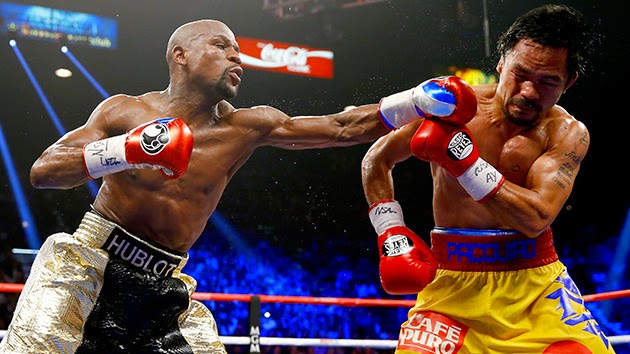
Mayweather v Pacman

Every decade, a fight or series of fights defines the decade, undoubtedly the 1920s and 1930s were the golden age of boxing as Jack Dempsey, Gene Tunney and the brown bomber Joe Louis fought consistently at venues like Madison Square Gardens and Philadelphia.
In recent history, I look to the 1970s with Muhammed  Ali v Smoking Joe Frazier for their three fight series culminating in the 1975 Thrilla in Manila, Ali again v the monstrous George Foreman in the 1973 Rumble in the Jungle or even the less promoted but no less exciting Ali v Ken Norton three fight series.

The 1980s gave us the middleweight duels with Sugar Ray Leonard, Marvelous Marvin Haggler, Tommy Hearns and Roberto Duran. The 1990s gave us the long awaited Evander Holyfield and Mike Tyson heavyweight match-ups and Jeff Fenech and Azumah Nelson super featherweight fights. Then the 2000s finally saw Danny Green v motormouth Anthony Mundine for the Australian grudge match in 2006. East LA golden boy Oscar De La Hoya fought a much younger Floyd Mayweather towards the end of his career in 2007 where he was beaten by split decision.

After years of negotiations and false starts, the best pound-for-pound boxers of their era finally came together; fortunately for me I was in the Philippines to join in the pre-bout fever, unfortunately for me I was out in Palawan fight day and was unable to find out the result until much later afterwards.

The boxer v puncher match-up unanimously informs us while the majority of these bouts goes the distance, the boxer and not the puncher is victorious. So while a Mayweather and Pacquiao bout is likely to be the long awaited superfight it was promoted as; if Manny didn’t sit Floyd on his arse in the early rounds, the result was always inevitable. Floyd the technician with the tight defensive skills and counter-punching ability was always going to win on points otherwise.

No way was Floyd going to go toe-to-toe with Manny, why would he be sucked into fighting to Manny\’s strengths? His tried and proven tactic of jab, move and counter-punch from a tight defensive framework is his highly successful modus operandi. Mayweather is known to jab heavily early on in the fight to score points and win the early rounds then doing enough in the middle and later rounds to ensure no upset is recorded. That is exactly what we saw in Las Vegas – the better boxer retained his WBA and WBC belts with a sound and proven strategy whilst walking away with Pacquiao’s WBO title. With the huge build-up, it was a fight that could never live up to the hype…

US versus THEM

The old command and control management style is thankfully almost history. Unfortunately, a few old dinosaurs still persist in the workplace; they are slowly being replaced with more collaborative leadership styles. Yet, despite this seismic shift in leadership; the us versus them unfortunately exists in my workplace.

I am seeing plenty of instances of collaborative leadership styles requested in job applications yet I am still unable to see examples in my workplace. I’m glad Nicholas is teaching new style leadership principles, now all he has to do is go and slay some dinosaurs in the workplace and beat them into submission, people don’t respond well to coercion and threats.

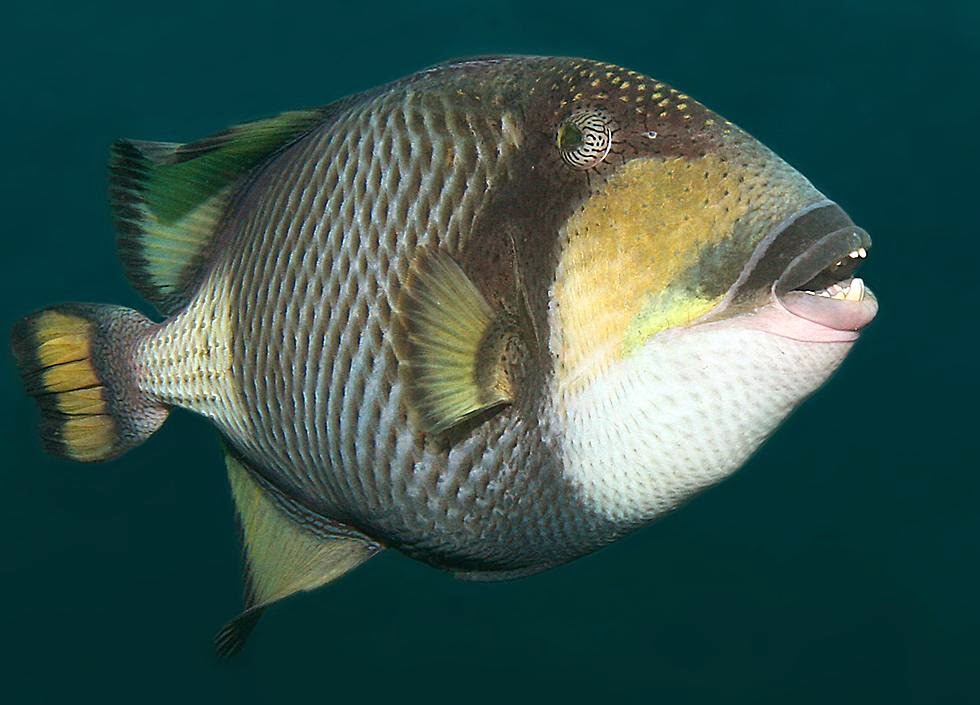
Hanging with a Titan trigerfish

I happened to momentarily glance up as I hovered over the reef concentrating intently on a small lifeform to see this large Titan trigerfish just before the moment of impact. Moving faster than a Manny Pacquiao left hook; about 4 inches from impact, I threw a short right hand defensive hook and feigned my head to the left with a lightning fast reaction that would have impressed Floyd Mayweather.

This was not as an elegant defensive move on my behalf as I had imagined; however, it had the desired effect as I stared at those large powerful jaws, I thought this fish was going to do some damage. I have viewed those powerful jaws crunch down on the reef at close range; I visualised those large teeth crunching through my mask and into my face causing extensive damage or maybe biting my ear off if I was silly enough to turn my head.

As the trigerfish withdrew for another charge; with dive knife drawn, I was then able to assume the more orthodox trigerfish dueling stance of fending off with my fin. I have been involved in numerous trigerfish duels and witnessed many others, so I knew what to do. My underwater guide thought this fight was hilarious and offered no assistance, this was a solo fight and strategic retreat; in other words, I tried to flee the scene whilst defending myself – I wasn’t enjoying this one bit. I couldn’t just swim off, they don’t just let you do that, that is just an opening to bite you.

The next day I spotted a Titan trigerfish busy chomping on a coral head, I quickly turned and left her territory feeling more than a little cowardice before I was spotted; I wasn’t in the mood to engage the enemy unless absolutely necessary. This dive trip saw another three trigerfish duels with two on a single dive, I am glad to say, none was as exciting as my first Titan trigerfish duel for 2015.

Economics and accounting completed

Having completed my first two units in my MBA along with the two units I was granted through advanced standing, I am asking myself why did I sign up for this? How could I inflict such pain on myself? My life is currently miserable – that much is sure. Every evening getting home from work to start reading and writing up case studies and assignments. I had two shorter online essays to research and write per week for Economic Principles and Decision Making and a larger case study due every fortnight plus online discussions and responses related to the topic.

My second selected unit is Accounting for Leaders; this is where I fell apart as I couldn’t keep up with the course load for two units and work full time. This unit required a major assignment every fortnight and a weekly short essay related to the module with discussion and responses. There is a fair amount of effort required for a single unit; two units are too much for me. I found I stumbled through the unit, now I am going to revisit accounting to over-learn this important skill.

I found my life just could not just be placed on hold and grind to a stop; I would head down to the shops to purchase groceries and would be rushing just to get back as I was eating into vital study time, no going out for dinner, no drinks out anymore and no entertainment. Even when the mail came in, the time required to pay bills was put on hold. This is really unsustainable, I was unable to sleep from the stress, extreme tiredness and fatigue. I couldn’t recall some of my posts and discussions – this is an unhealthy situation I need to rectify. I think of Jackson Browne’s excellent lyrics on Running on empty, that’s how I felt during my first trimester – never again will I undertake two units simultaneously.

I feel I am not learning what I am supposed to learn because I am so overloaded; I am really feeling the stress from being bombarded with so many concepts and information in such a short period. Whilst I am getting through the assignments, I really need to focus on the key concepts to embed the learning. What I don’t need is to accelerate the program, placing minimal time limits on learning is a poor strategy that can only increase my personal stress.

I have decided to concentrate on only one unit per trimester in order to embed learning; after all, I am not seeking merely a certificate to hang on the wall. I wish to attain a deep and through current theoretical and practical knowledge to increase my employment opportunities; so I am willing to add another year of study to ensure I have a deep understanding of the subject matter. It is going to cost more, this will increase the cost of the advanced degree – so be it. I am seeking a return on investment and if it extends my ROI by a further year, I am willing to belatedly accept that.

The MBA experience is to build leadership capabilities with a through grounding in the technical and analytic aspects of business management. Apparently the transfer of knowledge is an intensive and lifestyle destroying process that I am finding is less than a positive experience. I must ensure I really gain a lifestyle advantage from the lifestyle I am currently forgoing in order to improve future employment opportunities.

For my next unit, I will undertake Managing Finance, focusing on the utilisation of financial data for internal decision making processes to address strategies to anticipate alternatives and evaluate advantages and disadvantages of each decision. Topics involve the cost of capital, risk management, capital budgeting, capital structure, enterprise evaluation and payout policies. I was applying for jobs despite not yet completing the course, this burnt up precious study time. This is the worst job market since 1991; this was not the greatest time to seek a change of career, still, the process has begun and eight units left to complete.

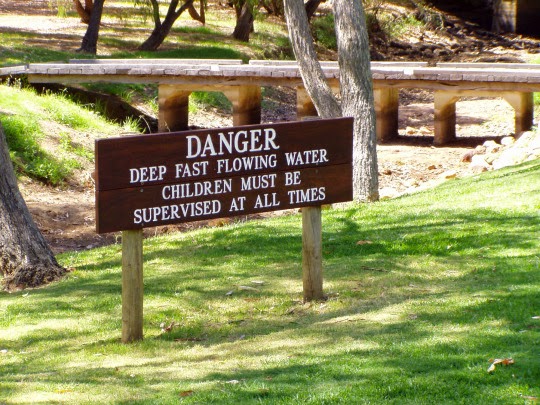
Deep fast flowing water – are you joking?

Whilst I understand the importance of risk management in our litigation based society – really? I think the little people may be at more risk of walking into the the sign and hitting their heads. Have they taken into account a sign warning about the potential dangers of the sign?


Do we need a sign for a sign? This is a creek, we know creeks are streams that flow into larger bodies of water such as rivers and lakes. Now we know any body of water has the ability to drown the unwary, do we really need signs to tell parents to perform the most basic duties? A better sign would be for parents to control their kids and not let them run amok.

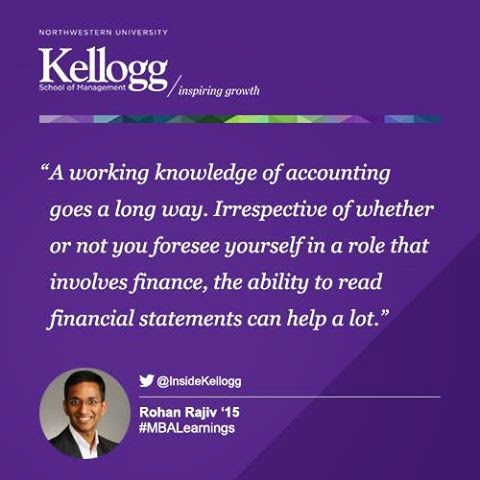
A knowledge of accounting

Totally agree with Rohan; whilst you might not be performing data entry or preparing journals or even trial balance; the ability to read and interpret financial statements is a skill contemporary managers need.

The foundations of an MBA program is based on analysis with the ability to interpret not only financial data; the ability to interpret economic data and relevant business information is critical. Whilst not every role requires operations management, marketing or finance, you had better believe analysis and accounting is the core of the decision making process.

Failed Labor governments

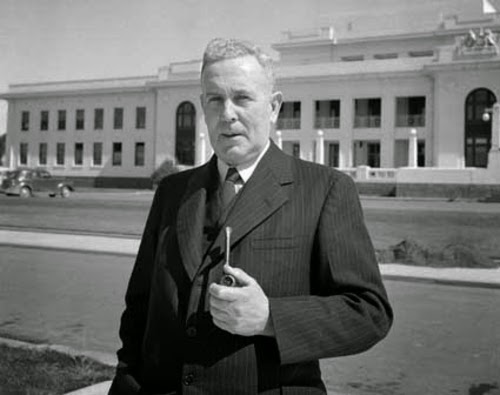
The sad truth is that Labor has run only one efficient government at the federal level since the Second World War. The Chiefly Labor government failed spectacularly, attempting to nationalise private trading banks with restrictive socialist legislation; the High Court of Australia ruled such legislation invalid. Arrogantly refusing to repeal the law; the incumbent Chiefly government took the issue to the 1949 election losing to Menzies.

Secondly, the Chiefly government attempted to retain wartime controls including price and import controls including rationing of what they determined scarce commodities. Even the communist controlled Miner’s Federation undertook strike action in protest; seven years of national emergency controls was accepted during the war, however, as socialism swept Europe, the lives lost fighting for freedom were not going to be meekly handed over now that the threat of national socialism had been defeated.

The ALP did not return to office until late 1972; after 23 years in the political wilderness, incoming Prime Minister Gough Whitlam rode a wave of popularity and was swept into office with the promise of change. However, his administration was beset by incompetence from the very beginning, dismissed by Governor General Sir John Kerr in 1975, it was a short and tumultuous period ending in economic disaster for Australia.

The Whitlam failure motivated future Labor leaders of the period to demonstrate Labor could run a modern economy competently and professionally. The economic rationalism drive was commenced by Bill Hayden in opposition contrasting the Malcolm Fraser do nothing approach. The reformist legacy was not only continued by Bob Hawke succeeding Hayden just before the1983 election, the program was accelerated under his guidance.

The Labor government headed by Hawke was highly successful in their early years implementing the Campbell report recommendations including floating the currency, reducing tariffs, the prices and incomes accord between the unions, compulsory superannuation and Medicare. The later years saw a deep recession in 1990 and 1991 take some of the gloss off the Labor government, public sector debt was an issue, never addressed seeing the Howard Liberal government return to office in 1996. The Hawke government proved equal to the task, this was the only successful Labor government.

Unlike Bob Hawke and Paul Keating, both Kevin Rudd and Julia Gillard were unabashed admirers of Whitlam and his government’s doubtful legacy. Rudd inherited one of the best-performing economies in the world, making adjustments to the global financial crisis somewhat easier than would otherwise have been the case. Low government debt coupled with strong taxation receipts from the mining sector, an insatiable thirst by China to consume Australian coal and iron ore, agricultural products and a gold price fueled by uncertainty. It was hard to actually bugger it up, but bugger it up they did.

Australia remained one of the strongest performing economies in the Western world. The problem with the Rudd and Gillard governments has turned on the implementation and/or mishandling of a range of policies. Including the carbon pollution reduction scheme, which became the carbon tax, along with the bungled imposition of a mining tax. Then there was the abandonment followed by the restitution of an asylum seeker policy aimed at controlling Australia’s borders.

The focus on the Labor party leadership essentially overlooked Labor’s policy problems; the inability to withstand Coalition critique led by then opposition leader Tony Abbott in late 2009. Julia Gillard’s assassination of Kevin Rudd, still in his first term as Prime Minister did not endure to the majority of voters stating the government had lost its way, the very government she was deputy Prime Minister from the outset. However, her leadership failed to resolve a number of high profile policy failures associated with the mining tax, luring more than 1000 asylum seekers to their deaths; continual government deficits despite announcing budget surpluses were top priority.

The decision to introduce the carbon tax, essentially the Greens party policy was viewed as the cost to stay in government at all costs making a mockery of the Australian voter. We all knew we had been played in a feeble attempt to run a minority government, the personal attacks on the opposition leader were a distraction, the misogamy claims were a desperate attempt to fool the politically illiterate. Tony Abbott himself is having a difficult time selling his government’s policy, despite his lack of personal popularity and the ALP and Greens controlled Senate are opposing his every move; leadership unity and bitter infighting will not bring this government down.

Organisational behaviour done, on to business ethics now

Heading out on holidays and bringing a textbook with me – madness or masterful? Many will argue this is the time to leave the stress behind, yet reading an excellent novel, I will always have in my mind I could be doing something productive.

Well, I suppose it depends on your point of view; this is not the first time, nor will it be the last time for me unfortunately. Where better than to do coursework? Lounging about in the tropics on a deckchair, the sound of waves crashing into the beach and the distractions of home left behind for a week.

I had a mini celebration, organisational behaviour done, now onto the dry subject of business ethics. I was going to be sitting on a deckchair anyway, it might as well be leading to a better future whilst enjoying the present. The deadlines don’t go away just because you are on holiday although I must admit, reading about business ethics did allow me to sleep easily on the deckchair. The sad fact is, for the last year I now hate my job as I have no confidence in the management decisions taking place. Had they taken the time themselves to study subjects of organisational behaviour and ethics, I wouldn’t be needing to study this myself.

Contingency plans – do we really need them?

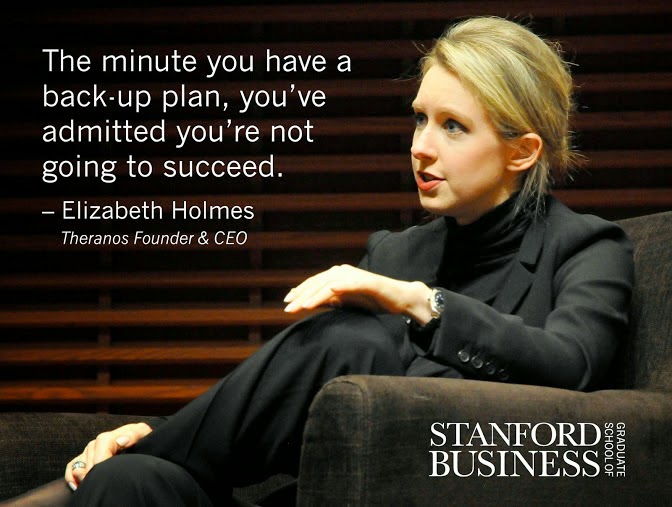
I totally disagree with Elizabeth; the very nature of contingency planning is to account for unexpected disruptions. Risk management is now the foundation of prudent business planning, what if sales don’t reach expectations?

What if a competitor launches a new product? What if a natural disaster disrupts a supply chain? You had better have contingency plans in place as a risk management regime instead of flying by the seat of your pants type operation. Military planning has frequently held troops back in reserve, what happens if in a military situation where the platoon or battalion leader is wounded or killed in action?

Is the next in command capable of taking over, it isn’t difficult to step on a land mine or be shot despite your best efforts to keep your head down and watch where you step. What is the chance of key personnel getting sick? The chances of staff being recruited by the opposition is high, can they be replaced? Is a succession plan in place?

Development of all staff is a key issue with all members capable of a) knowing the plan and b) having the capability to execute the plan. All formidable sports teams have contingency plans in case of game day injuries or match-ups of key personnel – you had better believe back-up plans are in place. Military planning is based on contingency factors, business strategic planning is based on internal and external factors to battle competitors.

Bali holidays

It is well documented that Bali is not the destination it used to be, this can be evaluated a number of ways. Bali is no longer the cheap holiday location it once was – true. In many ways, Bali has improved, it is now longer the open sewer it once was according to some. As a Bali holiday gets more expensive, what are the choices? Just take it or seek alternate sites elsewhere?

So where will replace Bali as the cheap destination for international tourists if the droves decide to desert the resort island? Another Indonesian location maybe? East Malaysia, Peninsula Malaysia, Thailand, Vietnam, Laos, Cambodia or the Philippines? What about Brunei or Myanmar? I guessing East Malaysia, the longstanding reputation of Tourism Malaysia, the competitive management of dive destinations is a positive, a significant downside is the issues facing Malaysian Airlines. Are the regional budget airlines suitably equipped to handle passenger traffic? For me, that is the main question to be asked.