Maintaining a dive log book

When I sat my open water course back 20 odd years ago, it was drummed into me the need for keeping a dive log – I thought it was the dumbest thing I had heard. Why bother? I had been skin diving for years and never kept a log and now I was being told by some dive instructor that I needed to keep a log of my dives.

Nevertheless, I complied and filled out the logbook I was supplied on my course even though I thought it was pointless. After that, I maintained a logbook right up through diver courses until divemaster and assistant instructor level. I was considering becoming a dive instructor and needed 100 logged dives to qualify. As I had just over 250 dives before I began my divemaster internship and 750 dives after my assistant instructor qualification and second working season, I didn’t require a stamped logbook after that.

Ironically, as a dive instructor I spent countless hours helping people fill out and stamp their log books even though I was keeping a basic log of dives such as location and depth. For me, even more ironically, I had my own instructor stamp to complement the shop stamp. What I found was people loved this stuff, they love collecting stamps in their logbooks in much the same way people love getting stamps in their passport – it looks like I have come full circle.

A dive briefing

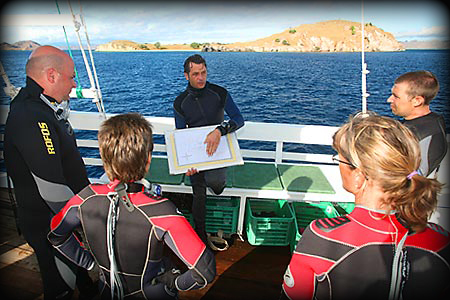
Having dived in the Mediterranean, I have been accustomed to European style dive briefings. Likewise, in Australia, we standardised dive briefings at many dive operations to mitigate any possible legal ramifications. We made sure we were meeting voluntary codes of conduct.

We had boat briefings and dive briefings printed on laminated sheets in bullet point format so as to not miss an important point, the actual briefing was then left to the finesse of the staff member and their personal delivery. It is a fairly standard risk management practice; not only that, it is best practice to inform the divers in your charge of boat procedures and potential hazards.

So when I dive in South East Asia and I receive no briefing from the moment I walk into the dive centre to the moment I hit the water, I wonder about the professionalism of the operation. I remember walking into a dive centre in Moalboal, Cebu – I was just left standing around and not even acknowledged as I stood there.

Eventually, one of the customers, yes, one of the divers and not the owner or staff showed me where to place my equipment, where the weights were, the washing facilities and departure times for the boat – unbelievable. During my week of diving at this dive centre, he was the only guy who actually spoke to me along with his friends, the owner and staff completely ignored me, the only time they spoke to me was when I paid the bill at the end.

That was naturally minimal conversation in order to complete the financial transaction – strange. Even more strange was the fact that this was a German owned and run operation, normally they are run with the famed German efficiency. On my next trip to the Philippines just a couple of months later, I was diving on Panglao Island and ran into Andre and his bunch of mates again. He was a prolific whore monger who had along with his mates had his bar girls out on the boat swimming and sunning themselves and generally playing up.

I was once again traveling alone and as he was once again already diving at this operation and gave me the rundown in lieu of an actual staff member performing any type of briefing. It was a fun party atmosphere on the boat with all the girls misbehaving and playing up outside the confines of the club where they worked – it made for a fun week, better than any of the staff provided.

Why I like Google Hangouts

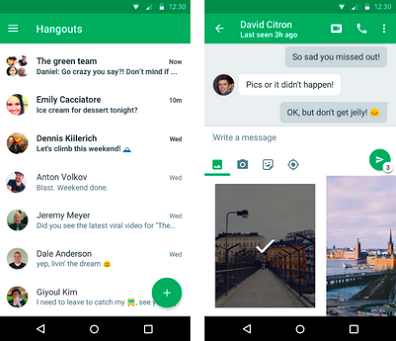
I really like Google Hangouts, I much prefer this communications platform over Facebook Messenger as I tend to have more privacy in this app. Once you are logged in with Google, you are logged into all their programs and they are all linked; although Google is not synonymous with privacy.

Google Hangouts has a much smaller user following than Facebook Messenger and I only have dedicated conversations with the people I am associated with. Getting friend requests on Facebook seems to get me involved with people I have never met or will never meet. As a Gmail account user, the chat function is also available when using my email account but I tend to have less requests.

When they separated Hangouts from Google+ I was concerned but I was able to access the app through the Google programs on my computer, tablet and phone. That worked out fine and I am able to receive messages on my phone. Facebook Messenger is such a large external program that always needs to be updated and my phone just doesn’t have the memory to support this program without deleting the material I have saved to the phone. There are no such problems with Google Hangouts and I am glad about that.

What is the value of the performance review?

Really, what is the purpose of the performance review? Why is so much anxiety expended preparing your response for an ill-prepared manager lacking the skills to execute a relatively straightforward meeting?

I sometimes wonder what the real benefit the performance review is to the organisation, we are having this meeting because all the other companies are holding performance reviews – that’s not a real reason. The trend in US corporations is to move away from performance reviews, there is plenty of evidence indicating the yearly performance performance is purely a paperwork exercise. So what other choices exist then? Tech company Adobe Inc is moving to an eight week process where managers and team members set mutual goals and check-in with managers to measure performance against goals – this is really an adaption of Drucker’s 1954 management by objectives incorporating Doran’s 1981 SMARTT goals. The old 1950s system as described by Peter Drucker is still the superior process – who would have thought.

Prostate cancer awareness

I was sent a message requesting me to post on my Facebook newsfeed a pre-written about spiel promoting prostate cancer awareness by a cut and paste message. I thought about it and reckon people really don’t take notice of these generic messages as their Facebook feeds are already cluttered. I thought I could do a little better raising awareness of prostate cancer symptoms by finding an infographic and promoting to a wider audience.

The most common symptom is difficulty urinating with a weak urine flow, I know this well not from a enlarged prostate but countless kidney procedures with what my urologist explains as caused by instrumentation scaring. Still not great but much better than the alternatives. These symptoms are pretty well known, but moving to erectile dysfunction, blood in urine or semen, a loss of bladder control, pelvic discomfort and bone pain paints a pretty break picture of what could occur.

So doing just a little research, I found out the early stages of prostate cancer are relatively symptom free – now that is a real issue. This was supported by a doctor friend who contracted prostate cancer and was treated in the early stages of the disease. I commented that it was lucky he is a doctor and picked this cancer up early, he replied that this was not the case; he only found out due to having to undertake a medical exam for a proposed trip to Antarctica. It goes to show that even well trained medical professionals have difficulty in picking up the early stages of this disease.

The 2017 Rolex Sea Dweller

The Baselworld Watch and Jewellry Show is the leading trade show for the international watch and jewellery industry showcasing prestigious brands, world class designers, industry suppliers and international dealers. The latest models, innovations, limited editions, upgrades and re-released versions of classic and heritage timepieces are usually released at this trade show.

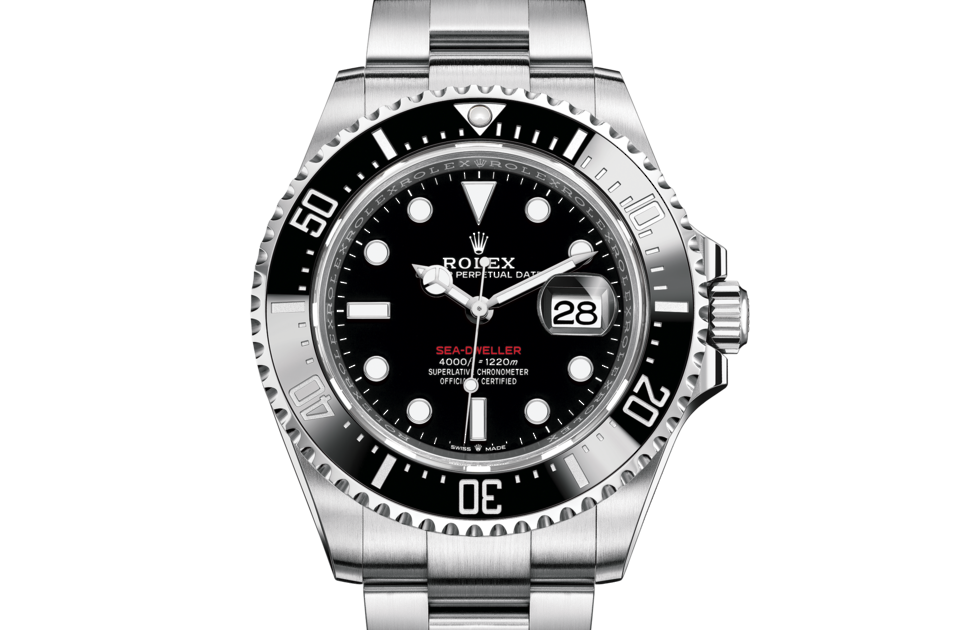
Rolex Sea-Dweller in Oyster, 43 mm, Oystersteel, M126600-0002, M126600-0002  | Watches Of Switzerland US

The Rolex Sea Dweller, pretty much a heavy duty Submariner was upgraded with a number of changes that tends to upset purists who believe watches should stay true to their heritage. I’m not so sure, I like plenty of the upgraded versions of classic timepieces but do understand that this distinctiveness created the foundation of the particular model.

Regardless, the case diameter of the Sea Dweller was enlarged from 40 mm to 43 mm making this a significantly larger timepiece. The real controversial addition is a cyclops loupe similar to the Submariner model was added to the glass over the date. The Sea Dweller inscription on the face was changed to red whilst the rest of the lettering remained white. The bezel retains the minute graduations around the full circumference of the bezel as opposed to the Submariner with graduations to only the 15 minute indicator.

The helium escape valve remains as well as the 1220 metre water resistance depth limit, four times the limit of the 300 metre Submariner. I like the upgraded version of the 2017 Sea Dweller even if I won’t be racing out to purchase one anytime soon. Based on feedback I have received from dealers, these upgraded versions are almost impossible for the average punter to get their hands on with a waiting list sometimes extended to years.

Gaining access to political figures

Speaking to my colleague involved in our internal Twittergate incident; he made a fairly astute observation that I would like to share. He believed that through social media, never before has the general public had such access to political figures – this is very much true. The senior management of public service organisations are now under more scrutiny than they have ever been before and rank and file members of the organisation have the ability to influence thinking like never before.

Possibly, no longer can bureaucrats filter information to heads of departments or political figures, now any government employee can post a comment on the page of a politician or public figure. This could possibly be a seismic shift in workplace dynamics; sure social media pages of politicians are usually monitored and run by staffers, but the staffers can and do bring issues to the attention of political figures. Also laughable, the director of human resources informed my colleague that our workplace, a state government department monitors the pages and profiles of key figures on a regular basis – now there is a great use of government resources.  

Laissez faire leadership failure

I was reviewing some old management evaluation posts for a business ethics class that I posted on our online Moodle forum for an organisational behaviour class I took back in 2014. This analysis was in regards to questions regarding evaluating my current manager that remain still relevant despite him occupying another position. Since that post, this particular manager has been moved on from what we were told officially was his excellent management track record. What I cannot confirm either officially or unofficially was that our strategic portfolio was investigated by the corruption and crime commission or better known and obstinately feared in Western Australia as the CCC.

While they were cleared from what I believe was a lack of evidence for serious misconduct, they were held more accountable for minor misconduct if such an investigation took place which I can neither confirm nor deny. So how do I know all this? Well, there was an anonymous report to the CCC, that is clear. I was dragged into the office and the finger squarely pointed at me and questioned at length in clear breach of reporting guidelines. I was repeatedly asked the same question with the same answer every time this time in clear breach of official workplace bullying policy.

Their view was that I had been persecuted and bullied by the management team because I wouldn’t engage in unethical and corrupt behaviour so it must be me making the report. Further slanderous comments of ‘sour grapes’ of my attitude of being overlooked for leadership positions that had been leaked doesn’t hold any weight as all positions within the state government work on a merit selection basis where the job has to be advertised with a transparent and reviewable formal process conducted – naturally, none of this occurred.

My short answer posted to the forum in relation to the leadership style of my manager turned out to be eerily accurate:

I actually have very little to do with my manager, this is due to his combination of laissez faire leadership style and his absolute laziness. One should not mistake his laziness for delegation and a participative management style or even empowerment; he simply seeks to unload his work onto others. Arguing against the laissez faire leadership style (OHalloran, 2014, September, 3) suggests “Utilising incompetent people to undertake high-level tasks purely because of enthusiasm in an attempt to force more competent people to work harder is not management, all this does is diminish the capability of the organisation.” Furthermore, favouring people who hold similar religious views is not a principle for rewarding behaviour.

My manager favours certain employee behaviour; they are generally the ones who provide him the least stress allowing him to perform a minimal amount of work. The transformational skills of a leader require communicating a vision, Schermerhorn et al. (2011, p. 316) believes visionary leadership brings a clear sense of the future with an understanding how to achieve this. Likewise, managers require advanced communication skills, OHalloran (2015, January, 5) believes “managers need to place a lesser reliance on hard technical skills instead possessing higher conceptual reasoning as they progress into a management role” Without communication channels utilised, a clear and compelling vision is unable to be communicated to team members.

References
OHalloran, J. (2014, September, 3). What is wrong with TAFE? Observations in an undemocratic world. Retrieved from. http://observationsinanundemocraticworld.blogspot.com.au/2014/09/what-is-wrong-with-tafe.html
OHalloran, J. (2015, January, 5). A functioning manager. Observations in an undemocratic world. Retrieved from. http://observationsinanundemocraticworld.blogspot.com.au/2015/01/a-functioning-manager.html
Schermerhorn, J., Davidson, P., Poole, D., Simon, A., Woods, P., Chau, SL. (2011). Management – Foundations and Applications, 1st Asia-Pacific Edition. John Wiley & Sons Australia.

The A-10 Warthog

The A-10 Warthog is a serious aircraft; although sub-sonic, the fixed wing close air support, attack and forward air control aircraft performs a serious role protecting the soldiers on the ground. As an attack aircraft, the role of close air support is a wonderful tool for the soldiers on the ground, they can be taking fire and call in a airstrike taking the enemy out very quickly. I have never served in the military but I do have an understanding and interest in engineering and this is a machine that interests me.  

The A-10 airframe is specifically designed for the 30 mm rotary cannon mounted below the cockpit for close air support missions. Due to its large wing area and high wing aspect ratio, the A-10 has superior maneuverability at low speeds and altitudes complimenting the attack role. Although the Thunderbolt is technically name of the aircraft, the Warthog is the name that has stuck – go figure.

There is some serious talk the A-10 will be retired to make way for the F-35 JSF; not because the A-10 is outdated or ineffective but because the F-35 may not be financially viable otherwise – it all comes down to dollars unfortunately. Of course, now that President Trump has tweeted his displeasure of the F-35 program, maybe the A-10 has an extended life. 

Twittergate and the perils of social media

A colleague of mine has recently been disciplined for the use of his personal Twitter account by making statements that may be seen as inflammatory. Whilst he may have been a little exuberant by personally naming the managing director and his place of employment – his questions were actually technically and factually correct. This then begs the question, even though social media codes of practice are in place, if the correct questions are being asked in a public forum using your personal account, what is the issue?

In Western Australia, a state election has just taken place with a new government sworn in, this also means a new Minister for Training and Workforce Development has taken control of this important portfolio and needs to know from a grass-roots level what the issues are. Anyone who has been involved with governments of any form know that bureaucrats only like to take good and positive news upstairs. Now my colleague had the best interests of students and their employers at heart, if trying to look after the interests of our key stakeholders in a public forum, is this a problem? Then we had better start making decisions transparent that look after our key stakeholders instead of taking a short-term approach disadvantaging the very people we are supposed to help. My colleague removed the posts (questions) from the parliamentarian’s Twitter feed and closed his account, but I fail to see how this has benefited anyone.