
Whilst I dislike the idiosyncrasy of US Secretary of Defense Donald Rumsfeld for his championing of the Iraq war, he did come up with some brilliant lines. Rumsfeld served firstly in the Ford Administration from 1975 to 1977, and then the Bush Administration from 2001 to 2006. Earning the title of both the youngest and oldest Secretary of Defense, he had a long career.
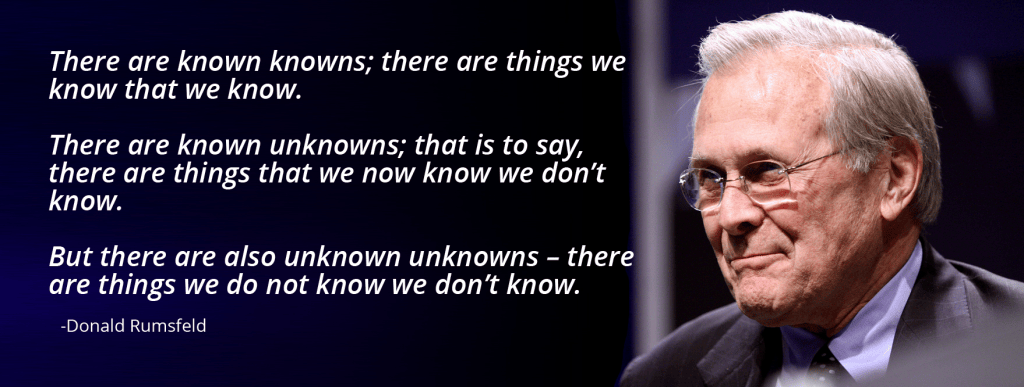
One of the Rumsfeldisms I would not like to be associated with is the Known/Knows descriptions. Whilst this description made Rumsfeld a laughing stock, it actually makes a lot of sense. I have problems remembering the full description off the top of my mead, now I carry a description in my notepad on my phone. It should be simple, it is either knowns or unknowns, it is just the order of the words that change.
The four states according to Rumsfeld are:
1. Known/Knowns – these are facts we are aware of.
2. Known/Unknowns – these are gaps in knowledge that we recognise, such as risks we are likely to anticipate
3. Unknown/Unknowns – These are threats or risks that are impossible to predict.
4. Unknown/Knowns – these are things we consciously or unconsciously overlook, a concept typically highlighted by critics.
This framework used by Rumsfeld is a psychology technique known as the Johari window emphasising intellectual humility in decision-making and was later used to describe the Rumsfeld Matrix. When Donald Rumsfeld returned to the private sector, he lectured for a short while at Princeton’s Woodrow Wilson School and Northwestern’s Kellogg School of Management, so he has a grounding in academic theory.

