Diving nitrox with Easy Diving – Sipalay

Much has been written on the advantages of diving nitrox; adding to the conversation, we know some of the nitrogen has been replaced with oxygen to decrease inert gas uptake.
No-decompression limits for a given depth may be extended as original air profiles are calculated with a nitrogen load of roughly 79% Using a 32% oxygen blend, the nitrogen is now reduced to 68% allowing an equivalent air depth to be calculated. A diver may descend to a given depth and calculate nitrogen upload at the reduced nitrogen amount allowing extended no-decompression limits. Whilst some suggest they feel better after a dive, there is no evidence to verify this claim although I admit to feeling less fatigued.

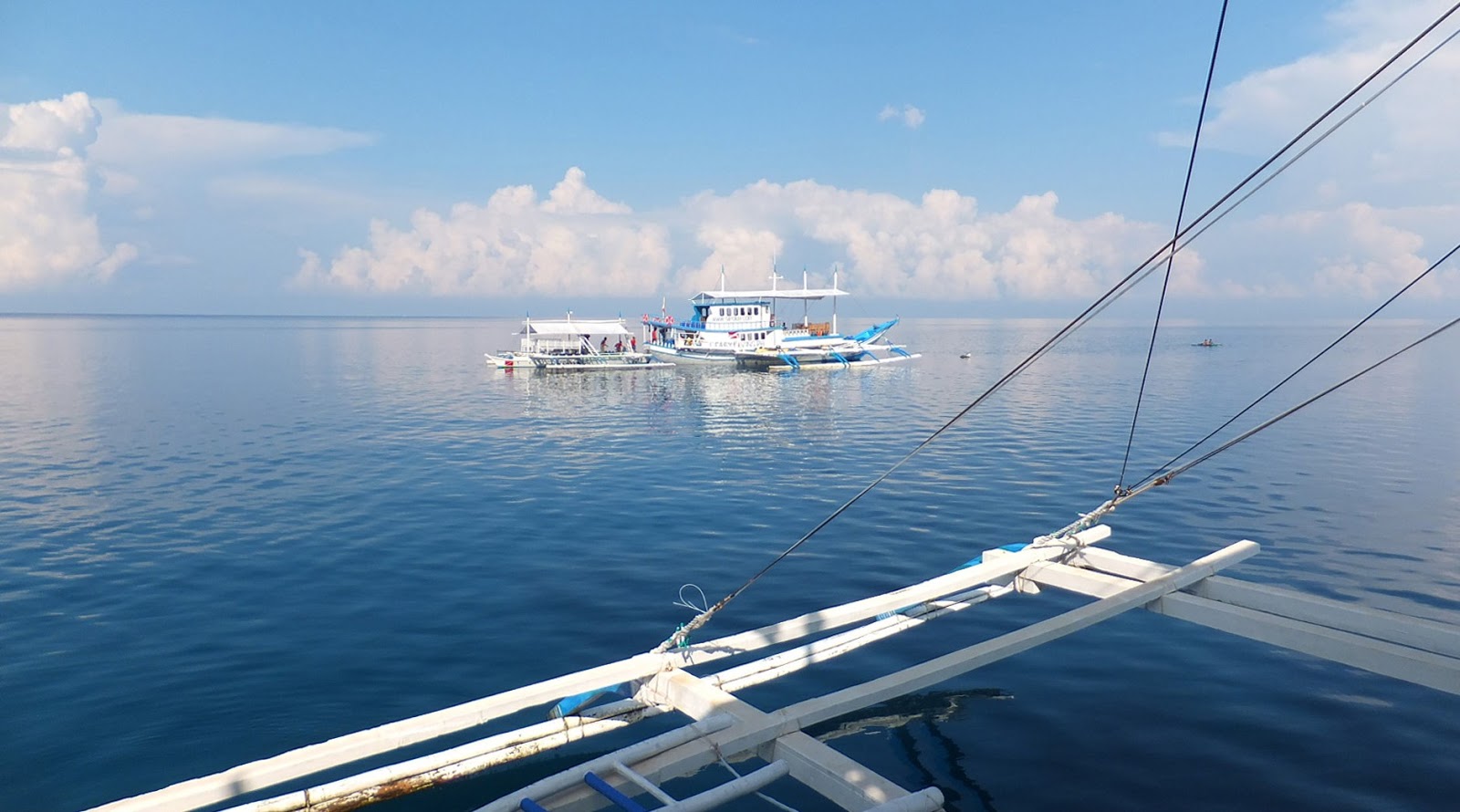
My dive trip to Sipalay, Philippines saw me diving with nitrox for free, a slogan promoted extensively in the Red Sea a number of years back. I see a real advantage of multi-level diving with nitrox in the 21 to 30 metre range. Whilst I prefer a 36% mix, most agencies err on the side of caution promoting conservative partial pressures of 1.4 atmospheres. I learnt nitrox with IANTD where a maximum partial pressure of 1.6 ata was used and a best gas mix of 1.5 ata was calculated to maximise the advantages of nitrox.

Regardless, EAN32 is the standard mix and although not the best mix for diving to 30 metres, this blend still offers plenty of advantages over air and since it is readily available, this is a good choice for many profiles. Easy Diving, a German dive resort in operation since 2003 offers nitrox to certified divers at no extra cost increasing bottom time without the need to limit time at depth. As most of the multi-level dives are within this range, any advantage allowing time at depth is greatly appreciated.

I noticed the dive centre offered a five-hour enriched air nitrox course to certify divers and unlock the potential of the area. As I have dived extensively throughout the Philippines, I have found it extremely rare to dive with nitrox outside of the high traffic areas of Puerto Galera and Bohol. Whilst technical dive centres offer nitrox for open circuit decompression diving and closed circuit rebreather, the use of nitrox is becoming mainstream in the Philippines. This is a dive resort aligned to recreational diving in some pretty pristine waters, they have good boats and outstanding service.

The cylinder contents analysing station is easy to use, it is connected to the wall, a base cylinder of air is used to calibrate the analyser and the individual cylinders are tested and the log filled out. In these days of easy nitrox diving, Easy Diving has their procedure well sorted. This process is simple, as Easy Diving uses a membrane and not partial pressure blending, the gas mix is always the same – you are just checking. The diver then sets their nitrox mix in their computer and they are off – this really is easy diving.
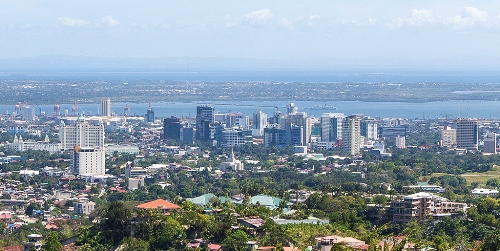
A quick trip to Iloilo City

I visited Iloilo city for a single day on a dive trip; I must say, I wasn’t much impressed with the city. Whilst I found the island of Panay reasonably interesting, I found Iloilo City dirty and run down.

They had a large shopping mall that I visited during the evening, there wasn’t much going on during a Sunday afternoon. Saturday night wasn’t exciting, it was a boring Saturday night. Due to the ineptness of Cebu Pacific, my morning flight saw me arrive after dark on Saturday night so I never got to create a great first impression. The city really needs to get their act together, they need to get the roads fixed, the footpaths neat and straight and the rubbish cleaned up. If the city is left dirty and run down, the residents will lack the pride in the city and treat it accordingly; this is a city in a dire need of an facelift.

The art of storytelling

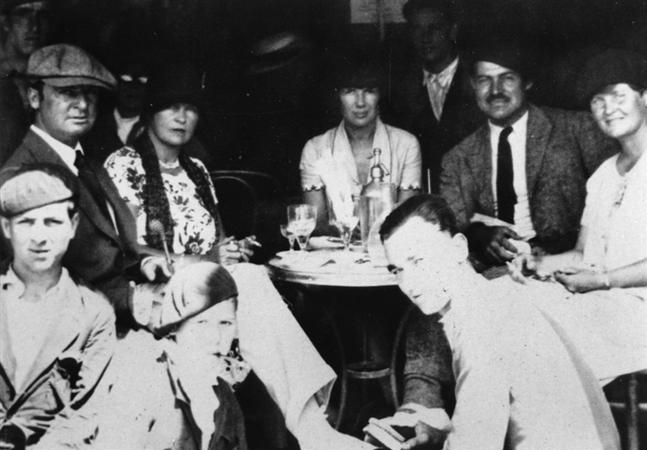
I look up to a number of authors, whilst I read modern literature, I think I prefer authors from a bygone era, their prose was free flowing and wonderfully descriptive. For me, I feel a sense of belonging with these literary greats, you feel part of the fun. Of my favourite authors of past eras are Somerset Maugham, Ernest Hemingway and F. Scott Fitzgerald as all three offer excellent explanations of life in Paris in the period of exuberance after World War I.

The Great War as is described took its toll on Europe with wide ranging ramifications for the whole world. Life in Paris was filled with fun and joy with the Bohemian set drinking and partying while no doubt collaborating on ideas and themes. Maugham was part of the literary circle who tends to float in and out, Hemingway was the larger than life figure who partied hard with Fitzgerald writing his epic novel of the jazz age in the lead up to the stock market crash of 1929.

I began with reading Fitzgerald’s short stories and essays before moving onto his masterpiece The Great Gatsby. Likewise, I have volumes of Maugham’s short stories but The Razor’s Edge is what sets Maugham apart. Whilst Hemingway’s masterpiece is The Old Man and the Sea, written at the end of his career down in Cuba is his famous work. For Whom the Bell Tolls, Death in the Afternoon and The Sun Always Rises are my favourites along with his short stories and essays.

The Baume & Mercier Clifton series

I really like the look of the Baume & Mercier Clifton series timepiece; this elegant timepiece is well marketed seeking a somewhat more distinguished customer not following the well worn trends of sports watches.

Whilst I probably won’t be racing out to purchase a Baume & Mercier anytime soon, I am happy to admire this timepiece as an interested consumer. I particularly like the marketing approach of the stylish European gentleman who follows his own style instead of being a trend devote – well played. Unfortunately, Baume & Mercier doesn’t have the brand awareness of the major watchmaking manufacturers; yet, I have found myself drawn to the Clifton series. I did see their watches on display in Europe, less so in South East Asia and Oceania.

The Clifton is inspired by classic museum reference timepiece; I was under the impression that the Clifton series was an older style timepiece that remained on their list, but this is a relative newcomer to their collection. I first came across Baume & Mercier whilst wandering through some malls in the Philippines with entire stores dedicated to the Baume & Mercier range. Now that become acquainted with this manufacturer, I have noticed Baume & Mercier merchandising desks in major watch retailers internationally.

However, brand awareness remains an issue with sometimes up to a dozen or so stands in a crowded retail space. Sitting within the specialised watchmaker segment of the Richemont Group, Baume & Mercier are surrounded by prestige watchmakers with their collective marketing and distribution channels. This manufacturer has the exposure potential. Baume & Mercier really needs to attract classic timepiece aficionados portraying themselves as a viable alternative to the more notable and popular brands – I really hope they succeed.

The Vasse Felix Classic Dry Series

I have been a big fan of Vasse Felix wines for a very long time now. Whilst my favourites are their Margaret River cabernet sauvignon, shiraz and chardonnay; the classic dry range is worth visiting. The Classic Dry White is a blend of Semillon and Sauvignon Blanc with the citrus flavours of the Semillon complementing the passionfruit of the Sauvignon Blanc. Whilst summer is over for now, I will make sure I am stocked up for Christmas.

The Classic Dry Red surprised me, I had always thought it was a blend. So when I found out it was 100% shiraz, that was not what I expected, I had always thought it was a Cab/Shiraz blend. Even more surprising was 100% French oak maturation for 12 months, this was a mix one year to five year old barriques. For a very long time I thought the Classic Dry Red was a better drink than their Cabernet Merlot, I am reconsidering my preferences now. The Cab/Merlot is a pretty decent drop, but it is a different range to the Classic Dry Red and pitched at a different price point.

Laureate Australia – they don’t even accept the qualifications they award

We had an economic slowdown in Australia with a tight jobs market and stagnant wage growth. Whilst still employed, I was seeking to expand my career and began seeking enhanced job opportunities. In 2018 I applied for the role of Head of Learning Experience Design at Laureate Australia and never received a reply.

I have a Bachelor of Training and Development from an Australian university that wasn’t awarded by Laureate Australia. However, I did hold at the time of application twelve years experience in an educational leadership role and a Master of Business Administration from Torrens University. Whilst I fully understand that does not guarantee me a job, you would expect the university who awarded your highest qualification to at least offer a response regarding your application to an advertised job. I appreciate there may be better qualified and experienced applicants who applied, but surely your alumni would receive the courtesy of at least an acknowledgement of an unsuccessful application.

I did not even receive a reply from Laureate Australia let alone a shortlisting. It would appear that Laureate Australia does not place a premium on the qualifications they award. It certainly didn’t improve my employment prospects on this occasion. I spent a great deal of money on my Torrens University education, surely some feedback on why my application was unsuccessful would be warranted. When the qualification you received is not highly regarded from the university that granted the award that you are using to further your career. It is understandable that other potential employers will place even less emphasis and value on a Torrens University MBA than they do.

A casual retirement day

I joined the college in 2006 just as the mining boom was gathering pace, in some respects it was a difficult choice to make as the wages in the private sector are much higher. The attraction is the conditions of employment on offer and better than private sector benefits. Employment in Western Australia tends to be relatively shorter term than most developed nations, the long-term employee is a relic of a past era. So arriving in the Western Australian public sector was an eye opener for me, the team was long-term and nearing retirement.

Once these guys got in the system, they tended to stay long-term until their retirement date. This is influenced by employment practices of selecting mature and experienced workers. Although a minimum of five years post-trade experience is required; that is post four-year apprenticeship term. I came on board with a twenty year employment record including the mandated four-year apprenticeship served.

So I was very impressed with a colleague on his last day of employment, he was a fairly quiet guy who just got on with the job. He had taken long-service leave previously. This is a fully paid three month break after seven years continuous employment in the state government, one of the many benefits on offer. We expected him to retire immediately afterwards but his wife was still employed as a nurse and he just spent his days pottering around the house with a number of projects down his shed.

He was somewhat bored and actually happy to return to work until his wife retired and they could do stuff together – fair enough. So after announcing his retirement, Arthur worked diligently until his final day no slacking off and no long discussions. I came into the office for afternoon tea as I had spent the whole day supervising apprentices down the engineering workshops and just needed to sit down for a moment.

I had just taken a seat at the table when I saw Arthur get up, push his chair in and walk out of the office without a word to anybody or looking over his shoulder, he had finished his work and he was off. I was going to wander over and have a chat to him but never got the opportunity on his final day. I have not seen Arthur again and while some view Arthur’s final day as regrettable – I see this as a perfect exit, he pulled it off.

Why did kamikaze pilots wear helmets?

The obvious question is, why did kamikaze pilots wear helmets? After all, pilot safety wasn’t really a consideration. I can’t explain why the short guy on the end is smiling either – he must just be a happy guy.

Technically, they were not a helmet per se, they were a flight cap. So after re-framing the question, why did kamikaze pilots wear flight caps? The most obvious answer has nothing to do with pilot safety, it was mostly to keep his ears warm. I guess they wanted to treat their pilots well even though they were on a one-way flight – recruiting would have been difficult otherwise.

I was doing some reading and pilots during World War II would take off with their canopies open, I guess allowing a reasonably easy escape should they crash during take off. In the early days of World War II, they may have been following the traditions of more conventional pilots. Especially during the later stages of the war, kamikaze pilots were sent on one way flights when Japanese command knew all was lost.

The dark art of leadership

I am astounded to actually witness a lack of leadership in the workplace; after reading text after text on the mechanics of leadership; all that it has served to do is enlighten me on the absolute lack of leadership displayed in my former workplace.

However, this leadership vacuum in my former workplace has been somewhat to my advantage, I am able to fill the void to provide direction, purpose and motivation. Then never learned that a vacuum has to be filled by something – a bit of an oversight. Likewise, I have also been able to fuel what would be considered by some as uprisings from the workforce when needed as the team leader does not act in the best interests of the team. The old adage of keeping friends close and enemies closer is not applied here.

Leadership is a little more than hanging apparent inspiring posters up on the walls with pictures of eagles soaring on thermal currents or mountaineers standing on the edge overlooking the cliff face and canyon. Leadership is fulfilling a vision, providing focus, motivation, empowering team members and providing support; at times, leadership requires powers of persuasion and negotiation. If you are not doing this, then this isn’t leadership.

How a toxic workplace develops

I have been unfortunate enough to work in a number of workplaces that exhibit the characteristics of toxic work environments. This is due to the fact that I worked on a contract basis so saw plenty of varied workplaces. Fortunately, due to the contract style of work, I never had to stay there long but it was great to observe.

I believe organisational values is the key to creating healthy work environments; likewise, poor values at an organisational level becomes more apparent at an operational level. So how does a toxic workplace occur? Management practices go a long way towards the work environment and this includes personal agendas and empire building. On-going personal conflicts tend to spill over into most workplace relationships with the stress enveloping all in the workplace.

The chaos principal applies in toxic work environments where apparent randomness related to chaotic and complex patterns exist with feedback loops and repetitive factors occur. Whilst this is a mathematical function, for those of us that aren’t as competent at such an analytical level, we are still able to identify trends.

We have poor attendance in our workplace and this causes more stress, people have to pick up the work of those who are absent causing more resentment and conflict. As a starting point, we have poor management practices that act as the genesis of all the causes of workplace conflict driven by personal agendas and empire building. Solve the management instigated stress and workplace culture improves remarkably quickly.