Teaching business skills to dive operators

What hinders the growth of the recreational dive industry is the lack of business training and development for dive centre and resort owners. Notwithstanding, dive centre and resort managers fall within the scope of dive management professionalism. The certification agencies package and sell dive courses to entry level divers, continuing education for recreational divers and professional level courses yet they fail to adequately train operators in the virtues of dive centre management.

Dive certification agencies, under increasing competitive pressures lack the will to drive change through an industry sadly in need of leadership and direction. The focus of professional level courses is dive training, almost oblivious to the stark realities of the industry that they operate in. No dive certification agency offers a dive centre and resort management course aligned to business principles incorporating principles of leadership, pricing, marketing, operations, accounting and bookkeeping, finance and teamwork.

Whilst a full micro-economics course is not required, presenting the principles of supply and demand to business owners allows business owners and managers to analyse their business and local competition. Touching on basic principles of macro-economics allows managers to analyse the industry seeking expansion opportunities. Teaching the principles of strategy allows managers the ability to internally analyse their business to enhance their value chain allowing value adding leading to a sustainable competitive advantage.

No longer would the dive centre and resort manager immediately engage in a costly price war, they would have the knowledge and skills to develop a value added product or service differential and market their product to targeted consumers based on their strengths and not to the old fallback position of lower prices unless a focused cost leadership position is identified by careful value chain analysis and exploited by a prudent marketing strategy.

Antarctic sea ice growth

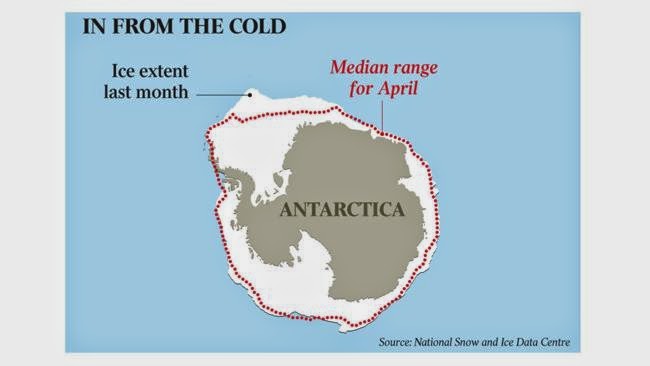
I have been viewing conflicting information on climate change, the National Snow and Ice Data Centre reported 2014 April sea ice growth was at record levels. NASA reported Antarctic sea ice data in September 2014 had increased; yet a number of agencies state Antarctic sea ice will completely melt in coming centuries and is unstoppable, what is going on?

I have to ask, how could the two leading agencies publish such widely different from conclusions from other agencies? Surely, one group of agencies has to be right and the other wrong – how could these conclusions differ so greatly? What are the implications of Antarctic sea ice growth over the period, surely this has to be positive?

We are now heading into a La Niña weather pattern following the El Niño phenomenon, the Pacific Ocean warmed three to five degrees during El Niño and summarily cooled by a couple of degrees below standard causing higher than normal air pressure in the Western Pacific and lower air pressure in the Eastern Pacific. As La Niña generally causes extreme storms with increased cyclones (typhoons in Asia) and heavy flooding, I will be eagerly following sea ice growth in Antarctica to see if it reverses current trends.

Finally fixing my inflator

I purchased an Apollo EX2000 BCD way back in 2002 and have never bothered to service the unit. For a long time it was my first choice BCD until it was replaced with a Scubapro T-Black and retired to travel duties. I worked on the theory that this was a reasonably lightweight BCD well suited for airline weight limitations, I also retired by jetfins from travel duties and replaced them with lightweight Mares x-stream fins.

The inflator hasn’t worked for about 7 years, since I never use it. I just disconnected the inflator hose as it self-inflated with the jammed inflator button – no big deal. My recent trip to Easy Divers in Sipalay saw me run foul of the dive centre management. The dive staff informed me of my constantly inflating jacket as they set my gear up as this is all part of the service here, my casual response didn’t impress the German dive centre manager.

When I told them not to worry about it they went into a flat spin, I have been diving for a decade in the Philippines and this is the first time I was questioned about the state of my equipment. They took my BCD off of me and quickly ran it through their repair centre. They stripped the inflator mechanism down, cleaned the internals and returned it to me – I was astounded.

Unfortunately I am a creature of habit and never used it during the trip. Once you are correctly weighed with a balanced scuba unit and old and beaten up 3mm wetsuit, there is no need to inflate your buoyancy control device – thanks for the repairs though. I understand and respect their position, they want to ensure all of their customers are using operational equipment and orally inflating a BCD didn’t impress them one bit.  

Running into deco

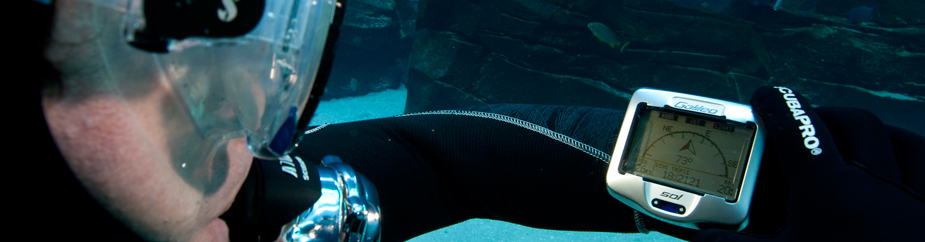
I had a conversation with a colleague in regards to his first 50 metre dive on air that entailed a small decompression obligation. Despite the depth, he was still concerned about allowing his computer slipping into required decompression stops. He expressed concern about allowing his Galileo computer to enter such uncharted territory as PADI had always maintained a no-decompression policy. Even as a PADI instructor, he expressed concern about decompression, the PADI instructor course (IDC) teaches you to teach – not dive.

The IDC assumes you have some diving experience, although 100 dives isn’t considered a whole lot of experience and a potential instructor only requires the advanced, rescue and divemaster courses – the minimum. Furthermore, the divemaster course is pretty light on dive theory as it is really a course designed to gain exposure as a teaching assistant.

At best, he would have had a few minutes at 3 metres to complete his mandatory stops. In essence, despite the depth, he spent just a short time at that 50 metre depth with the majority of his multi-level dive at significantly shallower depths. Now I’m not stating that divers should slip into deco and dive to depths beyond the scope of recreational diving limits without the training, experience, equipment and ultimately knowledge. I am stating that a through knowledge of dive computers should be taught at the supervised experience course between entry level and rescue – I can’t force myself to call it an advanced diver course. A higher level of knowledge is required for dive masters, assistant instructors and instructors.

What he didn’t require was a decompression stop regime requiring mandatory stops at 12 metres, 9 metres, 6 metres and finally 3 metres as the fast tissue compartments controlling his dive at depth was now controlled by the medium and then slow tissue compartments as he made his way up the wall. I knew the dive site well as I have dived this vertical wall numerous times. I also knew the top of the wall has a depth of 6 metres so he is able to off-gas in the shallows and I bet his deco ceiling had actually resided as he ascended.

Tulamben wreck diving

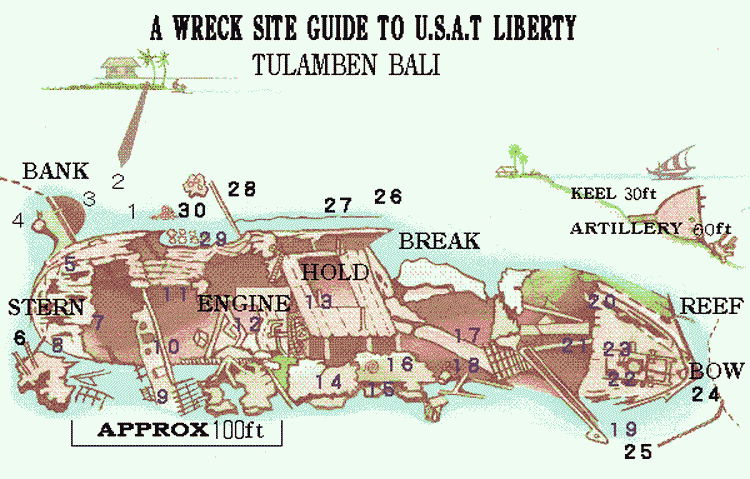
On trips to Bali, a drive up the island to the small village of Tulamben from the more developed areas of Kuta, Legian or Seminyak always results in a couple of dives. I have always thought this was a Liberty class ship of WWII; mistakenly named as the Liberty – I was wrong.

I have have only just learnt that the ship is in fact named the USAT Liberty, a cargo vessel nonetheless as a Design 1037 type and launched in 1918, there was close to 50 of this ship type constructed. This ship was torpedoed by a Japanese submarine in January 1942 and run aground in Tulumben where the ship was unloaded, a 1963 volcanic eruption pushed the ship into the water to sit in its current resting place.

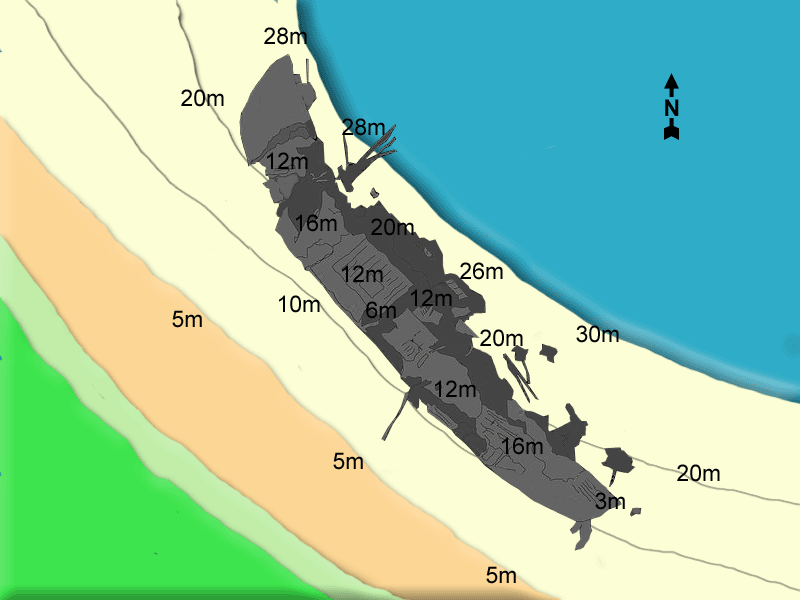
Walking in from the shore, the site quickly drops off to 20 metres and extending out to 30 metres. The site drops deeper, but there is no reason for chasing further depth as the areas of interest sit around the 20 metre depth. This is one of the premier dive sites in Bali, I would recommend this dive to all of my friends and I don’t mind diving this wreck over and over.

The 70:20:10 learning model

Hailing from a technical trade background, on-the-job learning is the preferred method of training with a 70:30 split of on-the-job and off-the-job methodology as fairly standard industry practice. Embracing the 70:20:10 training and development model; this current methodology is really built on the foundations of apprentice training that is ideally suited to workplace training and development.

The 70:20:10 learning model has been credited to Morgan McCall, Robert Eichinger and Michael Lombardo from the Center of Creative Leadership during the 1980s. However, many believe the origins of the model go as far back as 1968 with Professor Allen Tough publishing Why adults learn: A study of the major reasons for beginning and continuing a learning project, although he never mentioned the term directly, he planted the foundation seed.

Currently, the 70:20:10 model is being implemented in organisations with 70% of learning occurring on-the-job from experimental means such as action learning projects and supervised practice. Mentoring, coaching forms a further 20% of on-the-job learning with retention increased through a formalisation of the process. The final 10% of learning occurs off-the-job through structured learning interventions such as face-to-face courses, eLearning courses and webinars.

A dual Triggerfish duel

The first dive of the day saw us diving the Hole in the Wall, just around from Sabang Bay, Puerto Galera on the northern coast of Mindoro. A ripping current got us into the canyons with pelagics galore propping up in the current. I first dived this site in the mid 90s, eighteen years later, I am back for my fifth trip here. An extended bottom time saw a bluewater ascent with required decompression hanging from lift bags, pretty normal for here.

The second dive saw us back in Sabang Bay on a small wreck in a relatively shallow depth. On decompression dives I wear a dual computer for redundancy, this dive saw me wearing a Suunto D6, it was old stock from the dive shop and I decided to give it a try instead of selling it cheaply. The overly conservative nature of Suunto computers saw me back in slight decompression for this repetitive dive, no big deal I thought. The Titan triggerfish is a worthy adversary, a horrible and nasty fish the shape and colour of an Australian Rules football.

When I see one of these fish underwater, I sometimes feel the overwhelming urge to drop punt this aggressive undersea chomper; I am, of course not that bold and swim away as fast as possible usually.

I saw this one coming, the big Titan looks at you in a certain manner, turns on its side and comes at you. I was beginning my ascent and moving towards my decompression ceiling, I was mid-water at a depth of six metres moving towards my three metre ceiling.

Naturally, a triggerfish fights well in tandem and as you fight one off a second triggerfish joins the battle. Now you have a fairly robust battle going on with knife in hand and fin kicking hard whilst maintaining my decompression ceiling. You never seem to make contact with these guys, they are just too agile until you finally work your way out of their protective zone and the battle is over. Man, I hate triggerfish.

The Visa Black card

I was researching credit cards and came across the Visa Black Card; it struck some interest in me so I sought a little more information. Not that I am going to apply for this card, it was worth a quick look and I needed to investigate this exclusive card.

I struggled to see the value of the Visa Black Card, from the extravagant annual fee to the 1 point per $1 spent rewards – the benefits of this card really don’t add up. I am guessing the Visa Black Card is modeled on the American Express Centurion Card that lack both the prestige and functionality of the Amex card. Visa discusses the highest caliber of personal service offered but I fail to see why vendors will offer any greater service without financial inducements.

Double loop learning

Double loop learning was a term originally coined by Chris Argyris; his work influenced organisational learning theory, action research and the relationships created between the people and the organisation. Current organisational development, organisational learning and change management theories are seeking cost effective strategies to establish continuous organisational wide learning leading to a sustainable competitive advantage – double loop learning fits the organisational model.

According to Argyris, the theory of learning firstly involves the identification and secondly the correction of error. Where a fault is detected, Argyris suggests people look for differing strategies addressing work within the specified governing variables. So, given established values, goals or plans are deemed operational and not questioned. Such established rules are regarded as single-loop learning.

The alternative response is to question the governing variables subjecting them to critical analysis and thus described as double-loop learning. This level of organisational learning then leads to alterations in the governing variables shift the methodology that the strategies and consequences are constructed.

As I am a student of behavioural training concepts, the work of Robert Mager heavily influenced the formation of learning objectives and criterion based instruction. Changing learning objectives around goes against what I learned so it took me a while to get used to change learning objectives mid-instructional event. That being said, as an organisational learning program design, double loop learning is a successful training methodology.

Cashing in on my career

I have been fortunate in many respects in regards to my working life, I was well paid from an early age as I possessed the right skill sets for the time. Now I worked hard, really long hours every day of the week – it wasn’t a give me. An 87 hour work week was standard; yep, 12 hours a day for a 7 day work week. It wasn’t unheard of to work some overtime and easily break the 100 hour work week barrier. I once had a six week run of 18 hour days, starting at 6 am and knocking off at midnight, that was really grueling even for a 22 year old. I was saving for my house and I needed the deposit, needless to say, I was a pretty good saver back then.

Fast forward to now, it is time to cash in on my hard work, I need to enjoy life. I am writing this blog post sitting on a bench seat at Boat Quay in Singapore. I am still employed but I decided a decade ago to cash in on my good fortune. This weekend is a long weekend in Perth so no work Monday, I took some extra holiday days for Friday and Tuesday and I have a weekend away in Singapore. I also added the Thursday before and the Wednesday after as we are allowed to work from home one day per week and I have a pretty decent break. Yes, I have been to Singapore many times but as I had some expiring frequent flyer points that needed to be used straight away, I knew what I needed to do.

The emergence of budget airlines will allow me to undertake more short regional travel. I want to visit Jakarta, Taipei, Seoul, Osaka, Kota Kinablu and other South-East Asian destinations utilising budget flights and a few spare days over the weekend. I’m nearly 50 and it is time to start cashing in on my career fortunes, I’m not super rich and I don’t care. I am happy to spend my money and utilise my time constructively instead of sitting around at home counting down to retirement at age 67 when I will be too old to enjoy budget travel. Am I cashing in on my career or cashing out of my career?