
I have seen Alpina for sale in smaller retailers in Perth, Singapore and Manila. This is not a well known Swiss brand that has a high degree of brand awareness and brand recognition. For me, it is a little difficult to review as I have a hard time trying on models in showrooms. Founded in 1883 by Gottieb Hauser as Alpina Union Horlogère, Alpina has been around for a significant timeframe that should carry some degree of prestige at least.
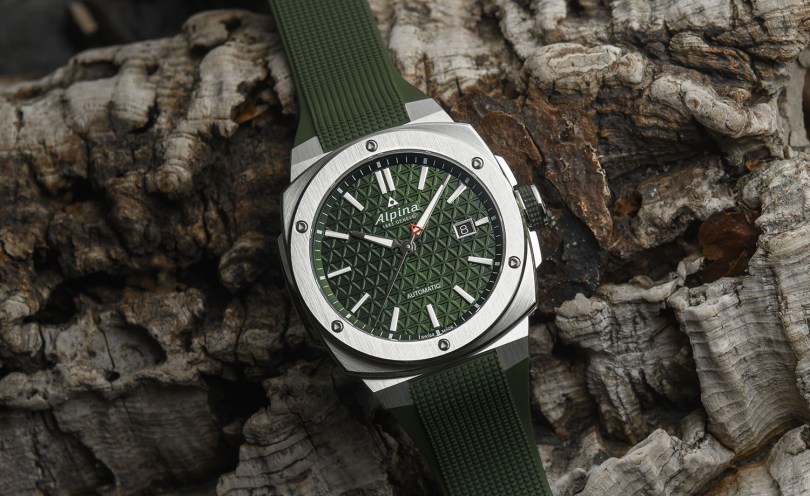
The case shape is extraordinary, the cushion shaped case design is symmetric, the round flat screwed brushed bezel accentuates the case shape yet maintains the Gerald Genta inspired design of an integrated bracelet architecture. The bezel screws have a triangle centre that resembles the Alpina triangle. The angled lugs are designed for an integrated bracelet; however, a rubber strap works well on this occasion. I have learnt the drawbacks of a less than stellar bracelet on more value orientated models, so a rubber strap interests me on these sports models.
The dial is reversing interlocking triangles, the applied index markers with a double marker at 12 o’clock. The red triangle on the second hand offers good contrast on the dial, the straight index markers work well with the angled chapter ring. The second markings on the chapter ring free the dial from clutter. The Alpina name, logo and Geneva/date reference under the 12 o’clock marker are clean, with only an automatic marking under that hand pivot.
The power plant is a SW200, a Sellita 26 jewel automatic movement with 38 hour power reserve beating at 28,000 vph with an Alpina rotor. Since the Swatch Group limited the availability of ETA movements to non-Swatch Group watch manufacturers, Sellita movements are fast becoming industry standard. Sellita provides a number of movements with a varying degree of finishing, typically Sellita provides a dedicated rotor to allow viewing through a display caseback.
The reputation of Sellita has improved dramatically, I tend to believe this was a poorly conceived strategy by Swatch management, they have offered Selitta the opportunity to increase market share and increase brand recognition. The increased sales has allowed Selitta to offer improved versions with quality advances. This is a reasonable quality movement built on ETA architecture that has an ease of supply with no restrictions, it was inevitable that Sellita would seek to unseat ETA at some stage with quality improvements and greater brand recognition.
 Observations in an undemocratic world