
IWC gained a reputation for pilot’s watches in the 1940s, the pilot watch was manufactured for the Luffwaffe in World War II. The 1950s saw the rebuilding of Europe, engineers working in labs were exposed to magnetic fields, the rebuilding of industries in the post WWII era saw advances in technology. The anti-magnetic capabilities of this watch prevented magnetism of the movement when exposed to excessive magnetic fields in engineering labs and workshops.
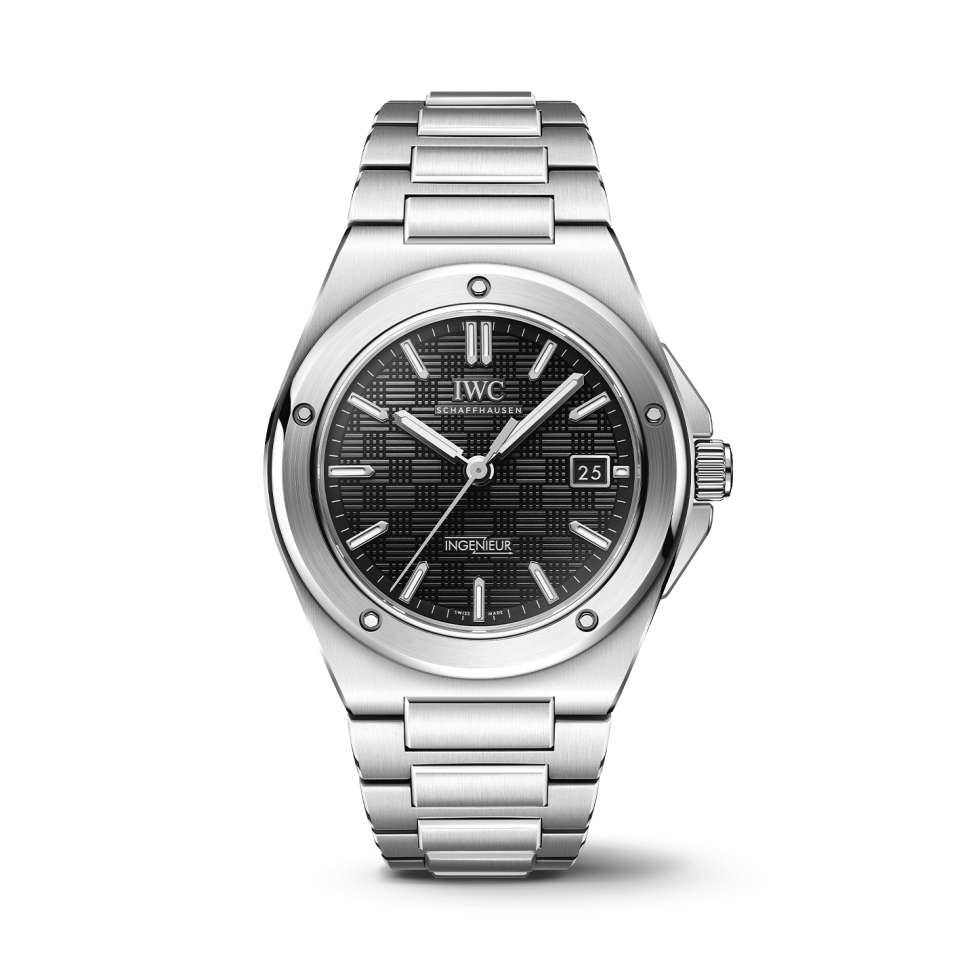
The Ingenieur predated the Rolex Milgauss that released in 1956 and the Omega Railmaster released in 1957, the Ingenieur was released a couple of years ahead of both of these engineers watches. The Ingenieur Reference 666 was released in 1955 followed by the Reference 766, the Reference 866 was released in 1967, one with a date and a no-date model.
The Reference IW3227 was designed by legendary watch designer Gérald Genta, the 42 mm case and integrated bracelet was big for the time. The IW3239 was 40 mm in diameter and thinner in thickness. Both the IW3227 and IW3239 featured a winged crown guard, both models had screws in the bezel.
The 500,000 A/M was released in 1989, the balance spring was manufactured from niobium-zirconium alloy. This alloy has a melting point of 2399℃, a density of 8.59 g/cm3 , a Vickers Hardness of 65 – 140 and tensile strength of 330 – 620 MPa. This is pretty serious material for a balance spring, the rotor had ruby ball bearings, other anti-magnetic materials were used for the pallet fork.
The 500,000 A/M was a commercial failure, the balance spring used innovative materials, however, the balance spring was affected by temperature changes, these temperature changes were more disruptive than the magnetic fields. There is a risk in innovation, the watch was produced, but was really not viable in a commercial sense. The movement was based on an ETA base 2892, the modifications for the ebauche were a good try, now the 500,000 A/M is seen as a collectable.
 Observations in an undemocratic world